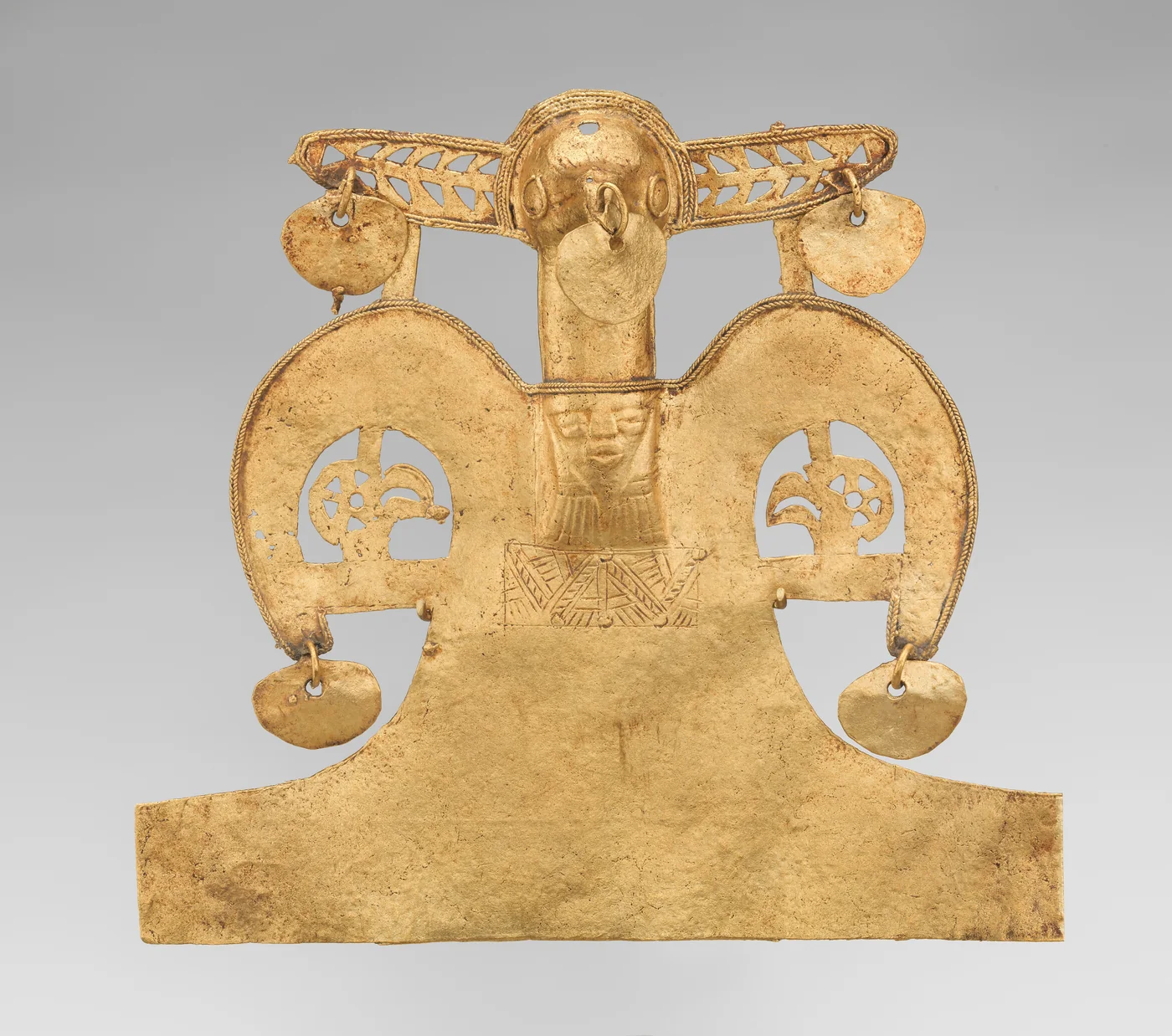
The museum identifies a Muisca bird pendant made through casting. Neither its silhouette nor uncertainty about the bird species establishes an ancient aircraft.
This object is a Muisca bird pendant from Colombia, not an aircraft model identified by its makers. The museum record provides a specific cultural attribution and a documented casting tradition. Those facts are more useful than grouping every small gold object with wings into a single mystery.
Which pendant are we examining?
The Met catalog dates accession 1979.206.509 to the tenth through sixteenth century. The cast gold pendant measures 10.2 cm high, 11.1 cm wide and 1.9 cm deep. Its decoration includes a human face, geometric elements and hanging ornaments. The museum does not identify the bird species.
The entry discusses construction from a wax model and describes the surface as unpolished. Its 1979 bequest is part of the collection history, not the date of manufacture. The Muisca attribution should also be preserved: a different Colombian culture's name is not an interchangeable label for this piece.
What does metalworking history add?
In the Met's original essay on Colombian metalwork, Héctor García Botero explains that regional traditions differed in their materials, production and uses. His discussion of Muisca offerings connects carefully made wax models with objects deposited in meaningful settings. That is broader cultural evidence, not a recovered account of this pendant's individual use.
It also cautions against judging workmanship only by a polished surface. A finish that looks unfinished to a modern jewelry buyer can reflect a different intended object and setting. Likewise, the generic category gold should not be converted into an exact purity claim without an analysis of this particular piece.
How should an aircraft theory be assessed?
Theory: the pendant depicts a flying machine. The first task would be to explain the entire design, including its human face and hanging elements, rather than selecting only a winglike outline. The second would be to identify supporting evidence for such machines within the object's historical setting.
A modern reconstruction could test the behavior of a chosen shape. It would still need a documented connection to ancient manufacture and use. Altering a replica's proportions or adding propulsion would introduce new design decisions rather than recover missing information from the pendant.
What is the strongest conclusion?
The evidence supports sophisticated Muisca casting and a bird pendant whose exact species is uncertain. It does not demonstrate ancient powered flight or extraterrestrial influence. Uncertainty about an animal identification is a narrow gap, not evidence for an unrelated machine. The Abydos inscription offers another example of why a familiar modern silhouette must be tested against the surrounding evidence.
Follow the sources
- The Metropolitan Museum of Art: Muisca bird pendant 1979.206.509 Undated collection catalog and public object record checked November 15, 2026. Muisca attribution, date range, dimensions and casting discussion verified. Photograph marked Public Domain.
- Héctor García Botero: Metalwork in Ancient Colombia The Metropolitan Museum of Art, December 5, 2024. Original museum essay reviewed for regional metalworking practices and qualified offering context.
- The Metropolitan Museum of Art: image resources Open Access policy and individual Public Domain object labels checked November 15, 2026. Saved API records for all seven objects additionally report isPublicDomain as true.
Each source note identifies the context and evidence it supports. Linked material establishes only the claims described in its source note. Official attribution and publication do not eliminate uncertainty. Read our editorial standard.
This is original, AI assisted research and analysis compiled from the linked sources. It has not received independent expert review. We distinguish source findings from our interpretation and record substantive corrections. Corrections policy