The evidence identifies an unusual ancient stone vessel. A machine function and an extraterrestrial origin have not been demonstrated.
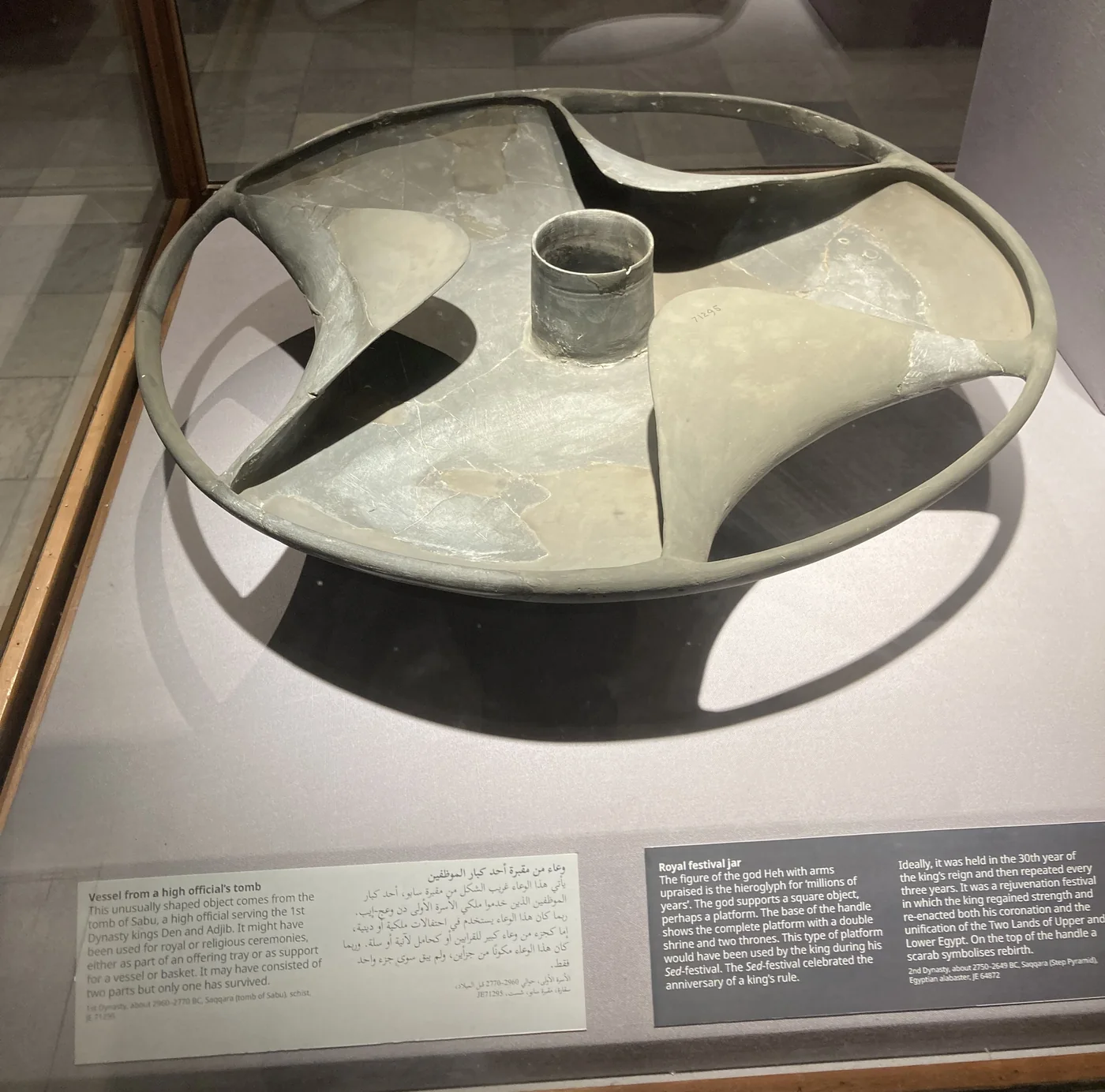
The Sabu disk invites a modern comparison before its archaeological context becomes visible. Three curved lobes surround a central opening, producing a silhouette that can resemble an impeller or a wheel. Yet a familiar shape does not identify an ancient object's function. The strongest starting point is the vessel itself, its burial context and the limits of the surviving record.
What was found at Saqqara?
Walter Emery excavated the object in 1936 from Sabu's tomb at Saqqara. Archaeologist Kristina Killgrove's August 11, 2025 overview places it in the First Dynasty, approximately 5000 years ago, and reports dimensions of 61 cm across and 10 cm tall. It was recovered in pieces and restored. She describes the material as metasiltstone.
The Egyptian Museum in Cairo identifies the vessel as JE 71295 on the label visible in our source photograph. It proposes possible ceremonial use, an offering tray or support for a vessel or basket. These are qualified interpretations, not a confirmed operating manual.
The archaeological comparison
Francesco Raffaele's 2005 study of early Egyptian stone vessels places the Sabu example within a wider tradition of skilled vessel production. Physical PDF page 3, footnote 9 identifies tomb S3111 and points to Emery's 1949 excavation publication. We checked that reference chain, but did not inspect the original excavation page.
Could the shape identify machinery?
An impeller comparison suggests questions that a mechanical interpretation would need to answer: what rotated, what supported the object, and what material passed through it? A useful test would connect those predictions to measurable wear, attachments or residues on the ancient artifact. A successful modern replica would establish what that replica can do under specified conditions; it would still require a link to ancient use.
The photographed object is therefore a receipt for sophisticated stoneworking and an unresolved function. It is not evidence that a matching modern machine existed beside it. The sources reviewed here establish no extraterrestrial manufacture. Keeping those propositions separate preserves the real mystery without replacing missing evidence with a technological label.
Read the comparison carefully
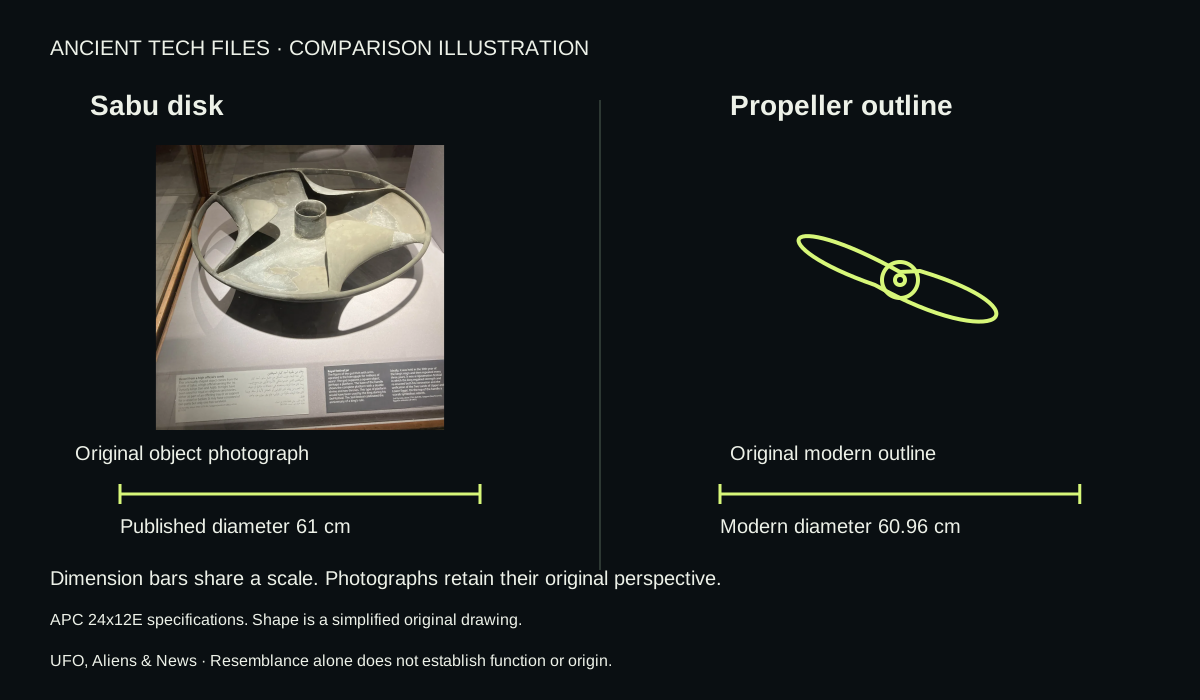
The original comparison diagram uses the vessel’s published 61 cm diameter and a modern propeller diameter of 24 inches, or 60.96 cm. Equal widths demonstrate scale, not interchangeable functions. The photograph retains its perspective and the modern outline is simplified.
Explore all seven Ancient Tech Files. A matching published Short has not yet been linked. These source pages can be read independently of a video.
Follow the sources
- Francesco Raffaele: Stone Vessels in Early Dynastic Egypt 2005; physical PDF page 3, footnote 9 identifies the Sabu vessel from tomb S3111 and cites Emery 1949, page 101 and plate 40.
- Walter Bryan Emery: Great Tombs of the First Dynasty, volume 1 Government Press, 1949; bibliographic record checked. The original excavation page was not accessible during this review.
- Kristina Killgrove: Sabu disk archaeological overview Live Science, August 11, 2025; secondary reporting of discovery, material, dimensions and archaeological interpretations.
- La Civilta Egizia: transcription of the Egyptian Museum object label January 7, 2023; secondary transcription identifying JE 71295 and possible ceremonial uses.
- Martin1833: Sabu disk and Egyptian Museum label Photographed October 15, 2023; CC0 1.0. The visible museum label identifies JE 71295 and gives qualified ceremonial interpretations. Image and label inspected November 15, 2026.
- APC: 24x12E dimensions Manufacturer specification, checked November 15, 2026; diameter 24 inches, equivalent to 60.96 cm. No manufacturer photograph is reproduced.
Each source note identifies the context and evidence it supports. Linked material establishes only the claims described in its source note. Official attribution and publication do not eliminate uncertainty. Read our editorial standard.
This is original, AI assisted research and analysis compiled from the linked sources. It has not received independent expert review. We distinguish source findings from our interpretation and record substantive corrections. Corrections policy