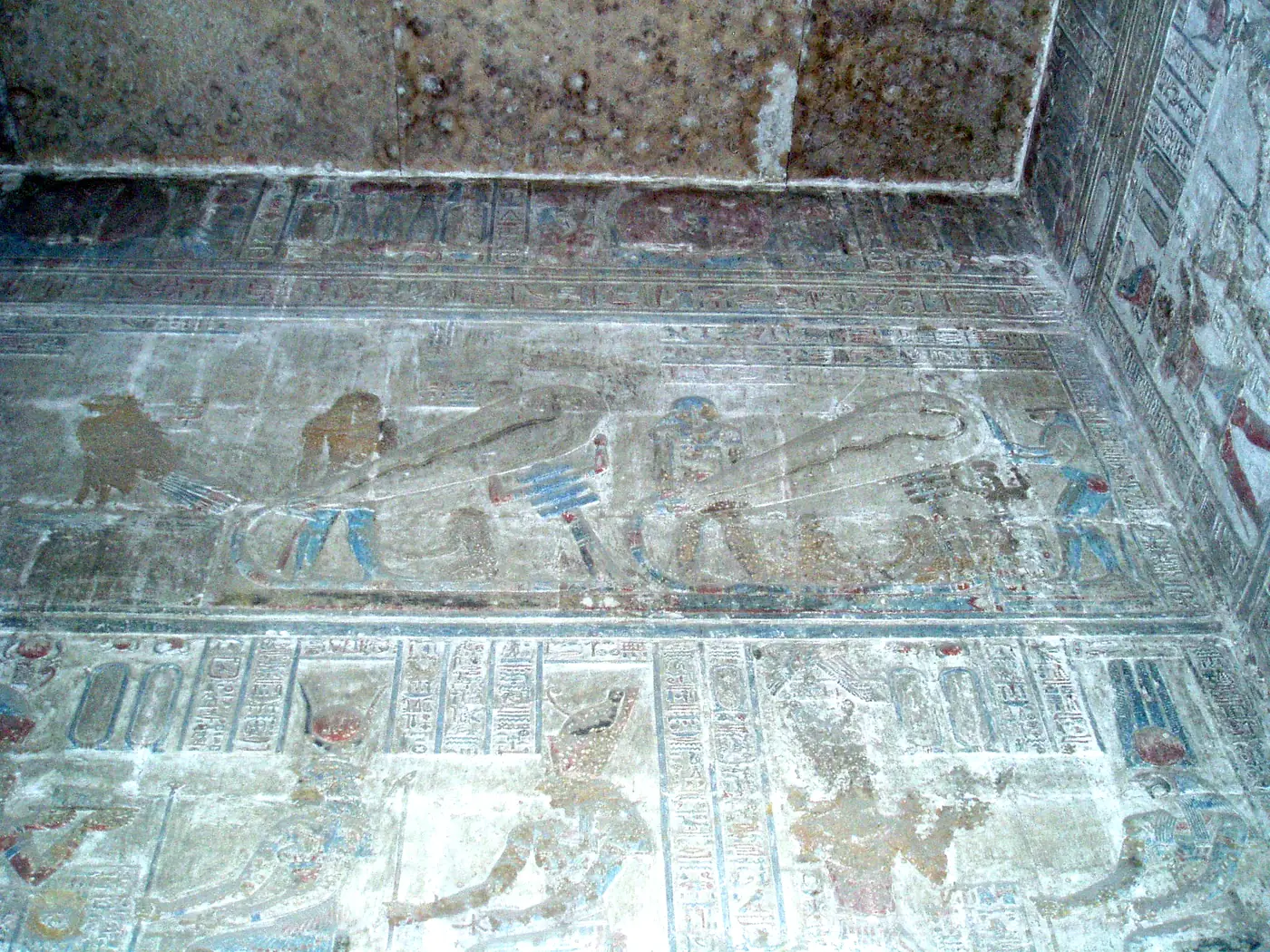
The accompanying texts support religious imagery involving Harsomtus and the lotus. The reliefs do not establish an ancient electrical lighting system.
The Dendera reliefs can look surprisingly familiar when a modern viewer searches for a glass bulb, a filament and a cable. That reading begins with resemblance. The investigation changes when the surrounding writing and the temple setting are treated as evidence alongside the silhouette.
A relief in a temple, not a recovered appliance
The Egyptian Ministry of Tourism and Antiquities places the surviving Temple of Hathor at Dendera within the Ptolemaic period. The familiar reliefs remain part of the monument. They are not separate museum objects with an electrical component catalog number.
Egyptologist Wolfgang Waitkus's 2002 study examines representations of cult objects in crypt South 1C and chapel G. The article places the lower crypt decoration at the beginning of construction under Ptolemy XII. Calling the reliefs approximately 2000 years old is therefore a rounded description, not an exact carving date.
What the accompanying texts identify
In the readable article text, Waitkus identifies the serpent as Harsomtus from the adjacent inscriptions. The lotus and emerging serpent belong to religious imagery concerning creation. He considers the cult objects very likely connected with the New Year festival. That qualified ritual interpretation should not be rewritten as certainty about every detail of their use.
The measurement trap
The study also discusses sizes stated for depicted cult objects. Those textual measurements are not surveyed dimensions of the carved wall. We did not verify the physical width of the photographed relief. A modern lamp shown beside it is consequently a conceptual comparison, not a measured match. Enlarging two pictures to the same display width cannot establish that their original objects shared a size.
What would an electrical interpretation need?
A proposed electrical reading must explain the inscriptions and offer evidence for components, connections and an energy source in the ancient setting. The image alone cannot provide those missing observations. Our public domain photograph records the relief as it survives; it records no working circuit. The scholarly reading provides a positive religious context, while extraterrestrial or electrical claims remain unsupported by the sources reviewed here.
Read the comparison carefully
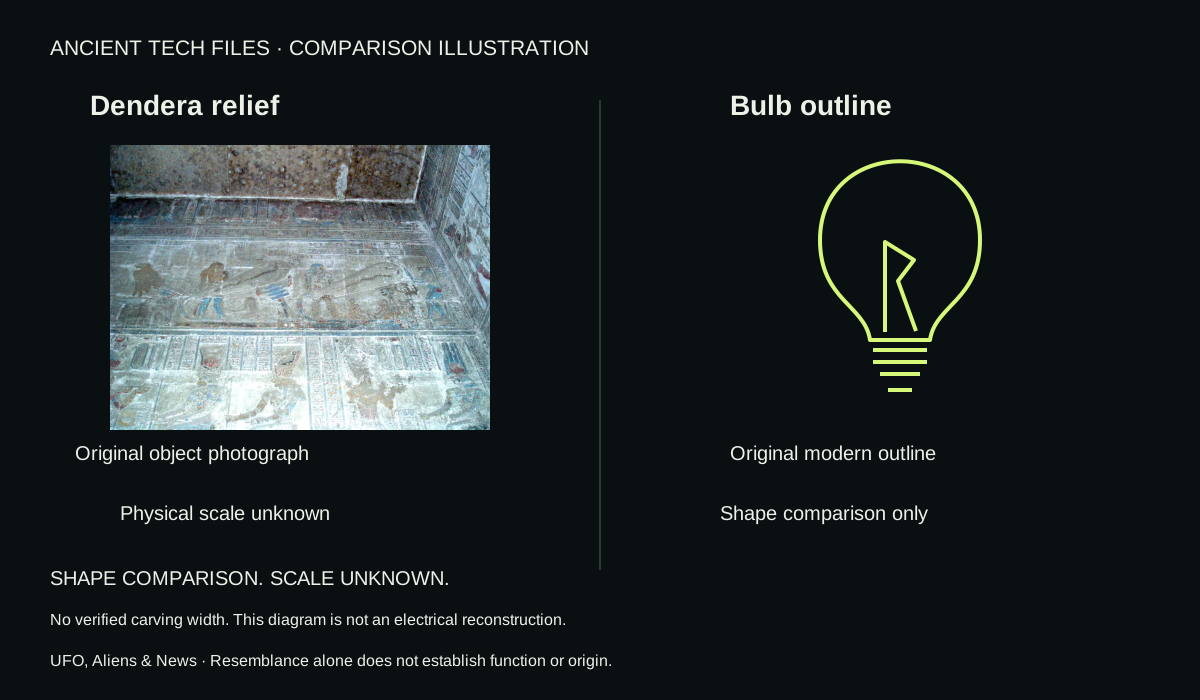
No verified physical width for this carving was established in this review. The bulb outline is therefore explicitly unscaled. Dimensions of cult objects mentioned in the Egyptian texts must not be substituted for measurements of the temple wall.
Explore all seven Ancient Tech Files. A matching published Short has not yet been linked. These source pages can be read independently of a video.
Follow the sources
- Egyptian Ministry of Tourism and Antiquities: Temple of Dendera Undated official monument record; Ptolemaic temple context, checked November 15, 2026.
- Wolfgang Waitkus: Harsomtus emerging from the flower Studien zur Altaegyptischen Kultur 30, 2002, pages 373 to 394; scholarly analysis of the cult objects and accompanying texts.
- Wolfgang Waitkus: readable article text 2002 article; pages 373 to 376 discuss Harsomtus, the lotus and probable ritual use. Copyrighted article linked for research, not reused as imagery.
- Rowan: Dendera Lotus01 photograph February 2007; photographer released the image into the public domain.
Each source note identifies the context and evidence it supports. Linked material establishes only the claims described in its source note. Official attribution and publication do not eliminate uncertainty. Read our editorial standard.
This is original, AI assisted research and analysis compiled from the linked sources. It has not received independent expert review. We distinguish source findings from our interpretation and record substantive corrections. Corrections policy