The surviving gears and inscriptions establish an ancient astronomical calculating device. Reconstruction questions do not establish an alien origin.
The Antikythera mechanism differs from an object that merely resembles a machine. Here, the surviving material includes toothed bronze gears and inscriptions connected with astronomy. The question is how the device worked in full, rather than whether every mechanical interpretation comes from a modern resemblance.
A wreck and a museum record
The Return to Antikythera excavation project describes the mechanism's recovery in 1901 from the wreck off the Greek island of Antikythera. The Greek Ministry of Culture catalog identifies the object as National Archaeological Museum, Athens, X 15087 and dates it probably to 150 to 100 BCE. That makes it approximately 2100 years old.
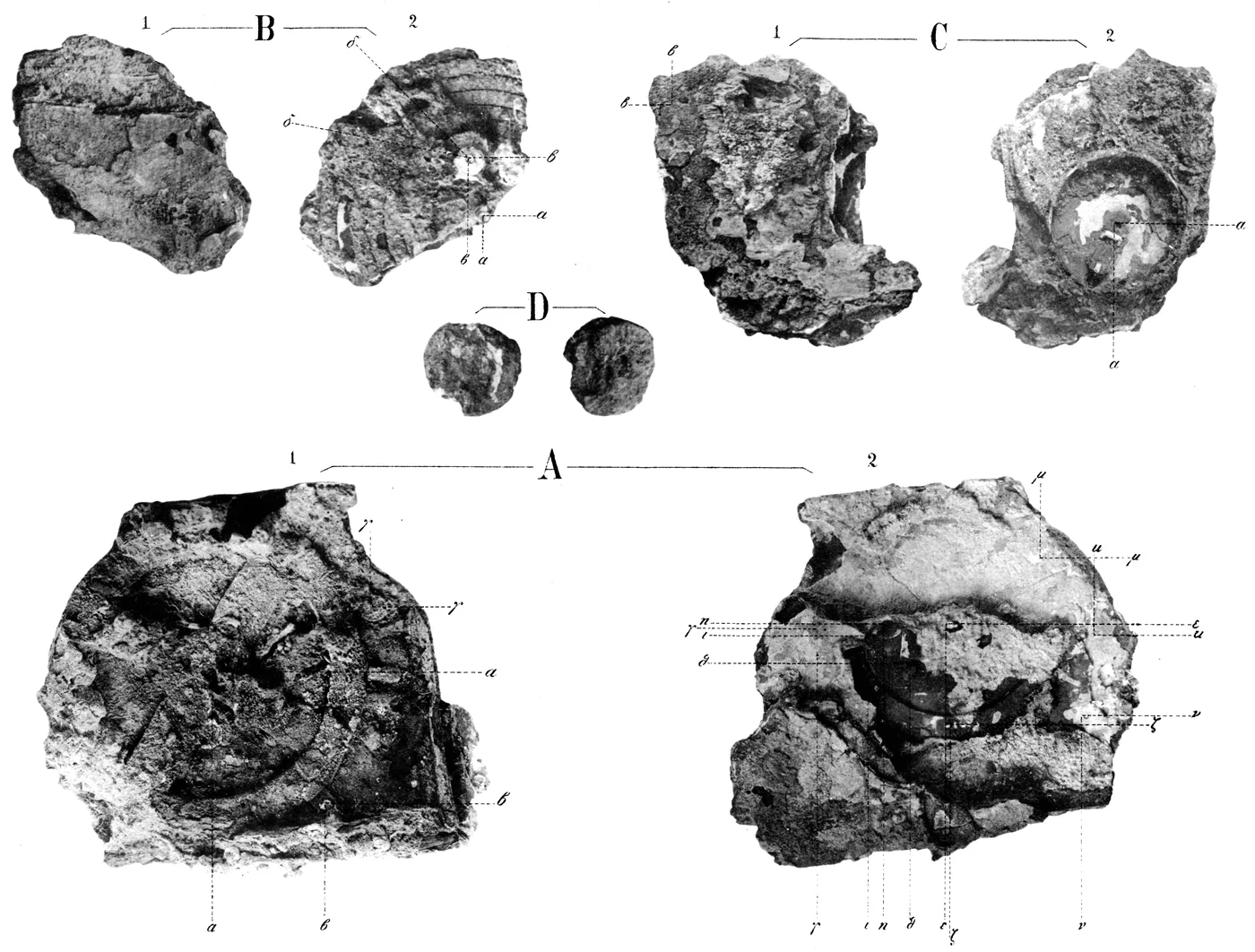
The catalog records 82 fragments and 30 preserved gears. It gives the largest dimension of Fragment A as 17.7 cm. Its proposed wooden case, approximately 33 by 18 by 10 cm, is a possible reconstruction. Those numbers should not be presented as measurements of a complete case that survives today.
What supports the calculator interpretation?
The ministry describes astronomical and calendar inscriptions, including instructions, alongside the gear system. The mechanism calculated movements of the Sun and Moon and probably the five planets known in antiquity. Its displays also addressed eclipses and calendar cycles. The word probably matters when discussing parts that are reconstructed rather than fully preserved.
What does the opening photograph show?
Our image comes from NYU's archive of photographs published by Ioannis N. Svoronos in 1903. It shows original Fragments A, B, C and D photographed in 1902 to 1903. The repository explicitly marks the image public domain. It is a historical view of the surviving material, not a photograph of an intact ancient calculator.
A real machine still needs careful reconstruction
A modern gearbox is a helpful visual comparison only if its different purpose is clear. Working reconstructions must account for the surviving teeth, shafts and inscriptions, while identifying components supplied by inference. Missing parts can permit competing designs. They do not turn the documented Greek engineering into evidence of extraterrestrial assistance. The stronger story is that an ancient machine can be real while details of its complete operation remain open to investigation.
Read the comparison carefully
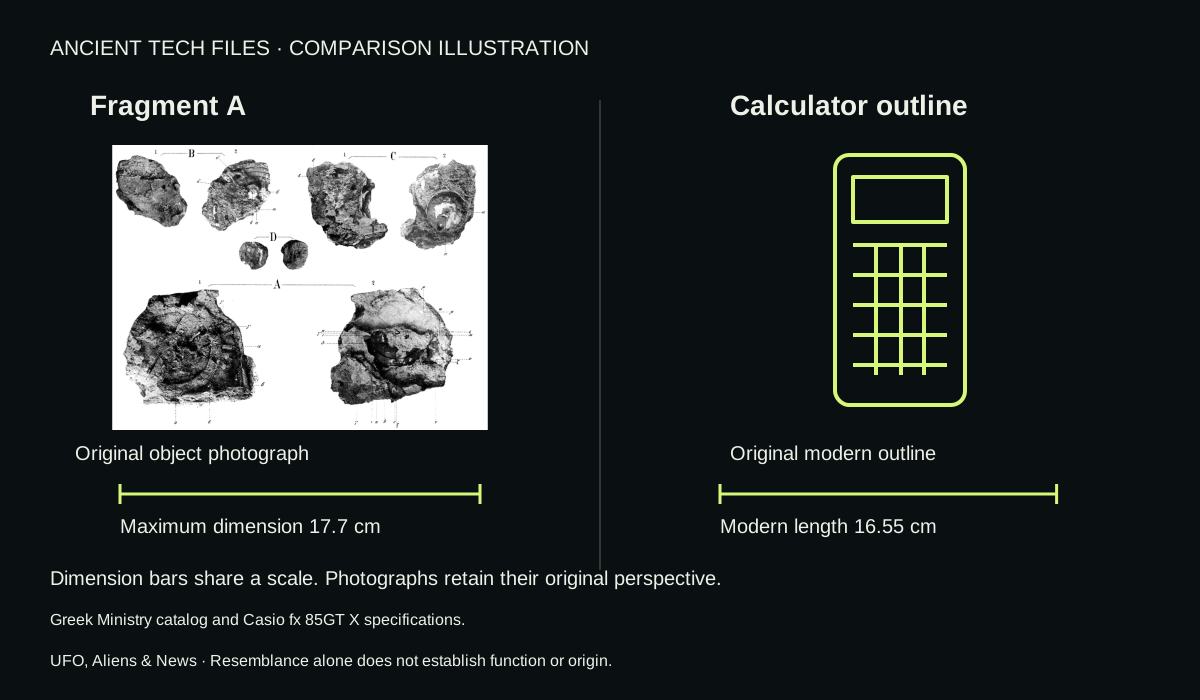
The comparison uses Fragment A’s published maximum dimension of 17.7 cm and a modern calculator length of 16.55 cm. The ancient measurement belongs to a surviving fragment, not the complete original device. The dimension bars share a scale; the photographs are not engineering surveys.
Explore all seven Ancient Tech Files. A matching published Short has not yet been linked. These source pages can be read independently of a video.
Follow the sources
- Greek Ministry of Culture: Antikythera mechanism catalog Undated collection record, checked November 15, 2026; Athens X 15087, probable date and surviving fragment dimensions.
- Return to Antikythera: the mechanism Official excavation project overview; undated, checked November 15, 2026.
- NYU Libraries: Svoronos photographs of the mechanism Photographs from 1902 to 1903, published in 1903, plate X; repository explicitly identifies public domain rights.
- Casio: calculator specifications Undated manufacturer manual checked November 15, 2026; length 165.5 mm. The comparison uses an original outline, not a product photograph.
Each source note identifies the context and evidence it supports. Linked material establishes only the claims described in its source note. Official attribution and publication do not eliminate uncertainty. Read our editorial standard.
This is original, AI assisted research and analysis compiled from the linked sources. It has not received independent expert review. We distinguish source findings from our interpretation and record substantive corrections. Corrections policy