Life beyond Earth remains an open scientific question. NASA’s reviewed sources do not establish a confirmed discovery, and an unexplained sighting alone does not establish an alien visitor.
We do not yet have a confirmed discovery of extraterrestrial life in the NASA sources reviewed for this guide. That leaves the existence question open. It does not demonstrate that Earth is the only inhabited world. NASA separately says that it has not established UAP as extraterrestrial. Read the agency’s current answer.
The word “aliens” can mean a microbe on another world, a distant technological civilization or a visitor to Earth. Evidence for one would not automatically establish the others. This guide keeps those questions separate and shows how to follow a discovery claim back to the observation behind it.
Which question are you asking?
- Could life exist somewhere beyond Earth?
- This is the broad scientific search. A suitable environment gives researchers somewhere to investigate; it does not demonstrate inhabitants.
- Has a scientific observation identified life?
- A possible sign needs testing against competing explanations. A promising result and a confirmed biological origin are different stages of investigation.
- Have aliens visited Earth?
- This needs evidence specifically establishing a visitor’s origin. A witness account, an official video or an unresolved report does not supply that conclusion on its own.
Our separation of these questions is a reading aid, not an official classification system. It prevents a common jump in reasoning: a headline about potentially habitable planets cannot, by itself, validate a story about a recovered spacecraft.
Why do scientists keep searching?
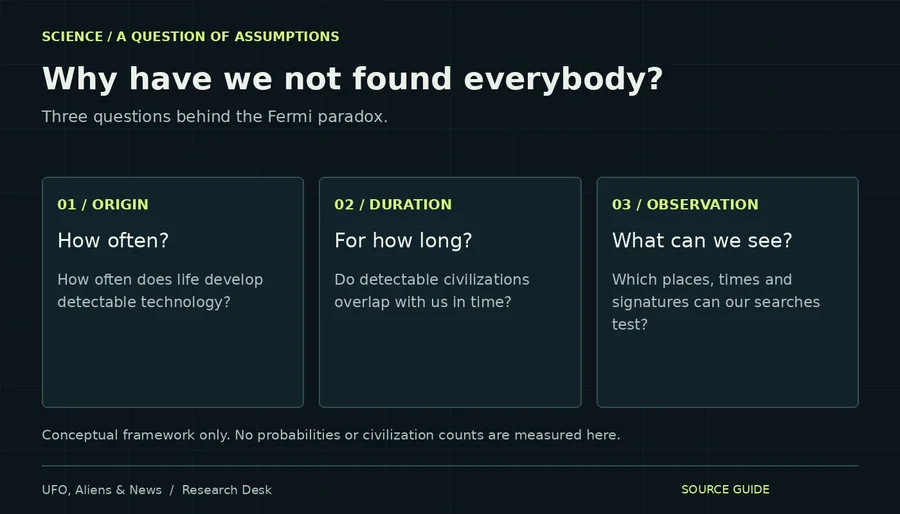
NASA’s search-for-life overview describes a galaxy with many planets but major unknowns about how often life begins, survives or develops detectable technology. Finding planets helps define the places to search. It does not settle the unanswered biological questions.
“We have not confirmed it” and “it cannot exist” are different statements. Equally, a vast universe is not a measurement of how common life is. A useful article should identify which observation changes our knowledge, rather than attach a confident probability to unknown quantities.
Has NASA found life on Mars?
A concrete example is NASA’s September 10, 2025 announcement about the Perseverance rover’s Sapphire Canyon sample, collected from Cheyava Falls after the rock was encountered in July 2024. NASA described potential biosignatures and said nonbiological explanations could not be ruled out. The finding was consequential without being a confirmed discovery of organisms.
NASA’s published biosignature explanation treats a potential biosignature as a feature that could have a biological origin but needs more investigation. “Potential” carries scientific meaning. Removing that word changes the claim. The 2024 observation and 2025 announcement are historical examples here, not fresh October 2026 news.
What would different searches detect?
NASA’s methods overview describes searches within the Solar System, studies of distant planetary atmospheres and searches for technological signals. An atmospheric measurement can suggest chemistry associated with life; connecting that chemistry to biology requires additional evidence. The physical setting and the possible sources of a signal matter.
- Biological clues: our K2-18 b guide separates a measured feature, a proposed molecule and a biological explanation.
- Signals of technology: our SETI verification guide explains how candidate signals are checked before an extraterrestrial interpretation is justified.
- Sampling decisions: our Enceladus sampling explainer follows the distinction between choosing a promising sample and detecting life.
Are UFOs evidence that aliens are visiting?
They can be evidence of a reported or recorded observation. The next question is what that evidence establishes about the object. NASA’s UAP FAQ says limited high-quality observations constrain scientific conclusions; it does not identify UAP as extraterrestrial.
Start with the meaning of UFO and UAP, then examine a specific case. Our Nimitz guide separates witness testimony from the sensor recording. Our government-files guide helps readers locate documents and distinguish the release of a record from verification of every claim inside it. These are different evidence paths, not interchangeable proofs.
What would make a discovery convincing?
In a 2021 framework proposal, NASA scientists described confidence building through checks on measurements, contamination, alternative explanations and independent follow-up. That proposal offers context for evaluating progress; it is not a rule that an agency can simply declare a candidate conclusive.
Our practical checklist is to ask: What was measured? Is the observation repeatable? What nonbiological or terrestrial explanations were tested? Can another team inspect the evidence and reach a comparable result? What would show the proposed explanation was wrong? The strength lies in answers that can be checked, not the number of times a claim is repeated.
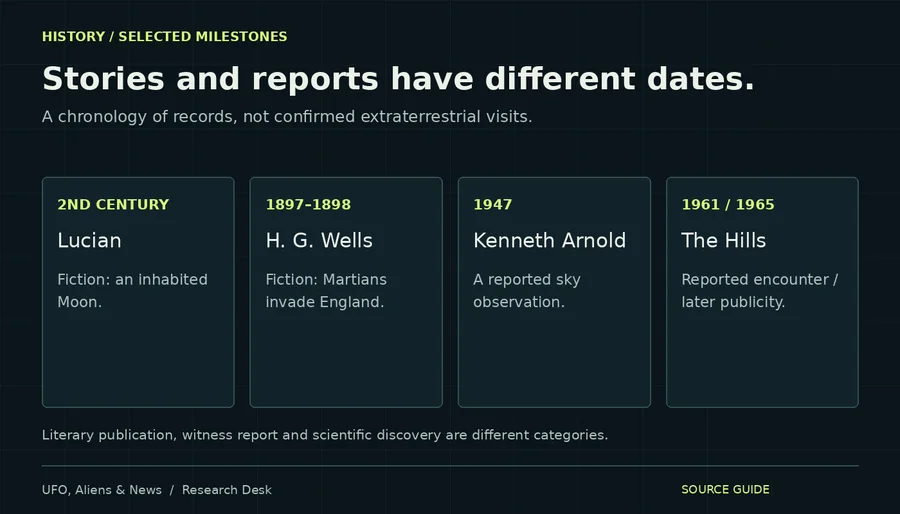
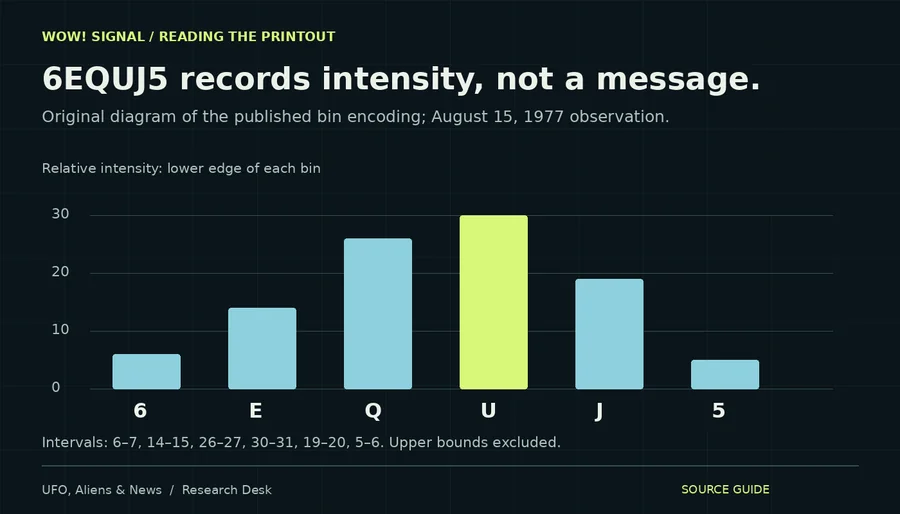
For the history behind the question, read when alien stories and reports first appeared. Explore the Wow! signal for a concrete observation, or the Fermi paradox for the assumptions behind expectations of civilizations.
How should you follow the next claim?
Read the original release before the commentary. Record the observation date separately from the announcement and repost dates. Look for the exact qualifier: candidate, possible, unexplained or confirmed. Then identify the next measurement that could change the conclusion.
Use our alien and UFO question directory to choose a research path, or follow updates through RSS. Our source notes below identify what was actually reviewed. This guide is an evidence overview, not an exhaustive review of every extraterrestrial claim, and it will be revised when substantive new evidence warrants it.
Follow the sources
- NASA: UAP frequently asked questions Current NASA evidence position and distinction between UAP and extraterrestrial life; text checked October 26, 2026 Pacific.
- NASA: Are We Alone? Search-for-life overview, exoplanets and unanswered questions; checked October 26, 2026 Pacific.
- NASA: Can We Find Life? Different search methods and the need for converging evidence; checked October 26, 2026 Pacific.
- NASA: Perseverance sample contains potential biosignatures September 10, 2025 release about a rock encountered in July 2024; agency report reviewed, not an independent reanalysis of rover data.
- NASA/JPL-Caltech: What is a Potential Biosignature? August 7, 2024 educational resource; published transcript reviewed. The video was not watched for this guide.
- NASA: a framework for assessing life-detection claims October 28, 2021 explanation of a proposed confidence framework; methodological context, not a new discovery or a universal certification rule.
Each source note identifies the context and evidence it supports. Linked material establishes only the claims described in its source note. Official attribution and publication do not eliminate uncertainty. Read our editorial standard.
This is original, AI-assisted research and analysis compiled from the linked sources. It has not received independent expert review. We distinguish source findings from our interpretation and record substantive corrections. Corrections policy