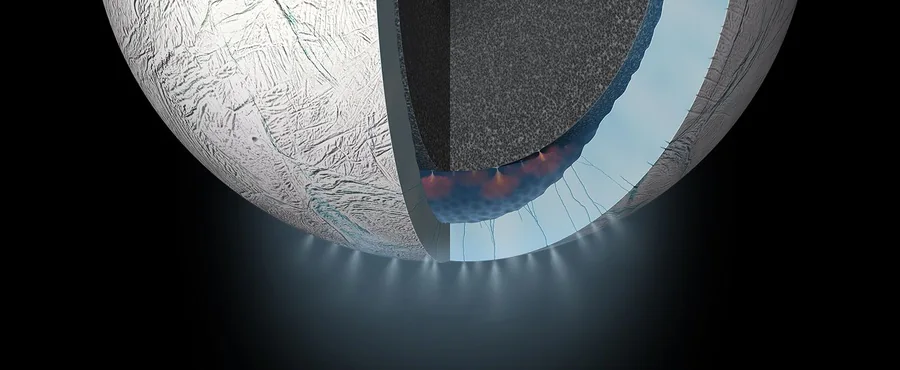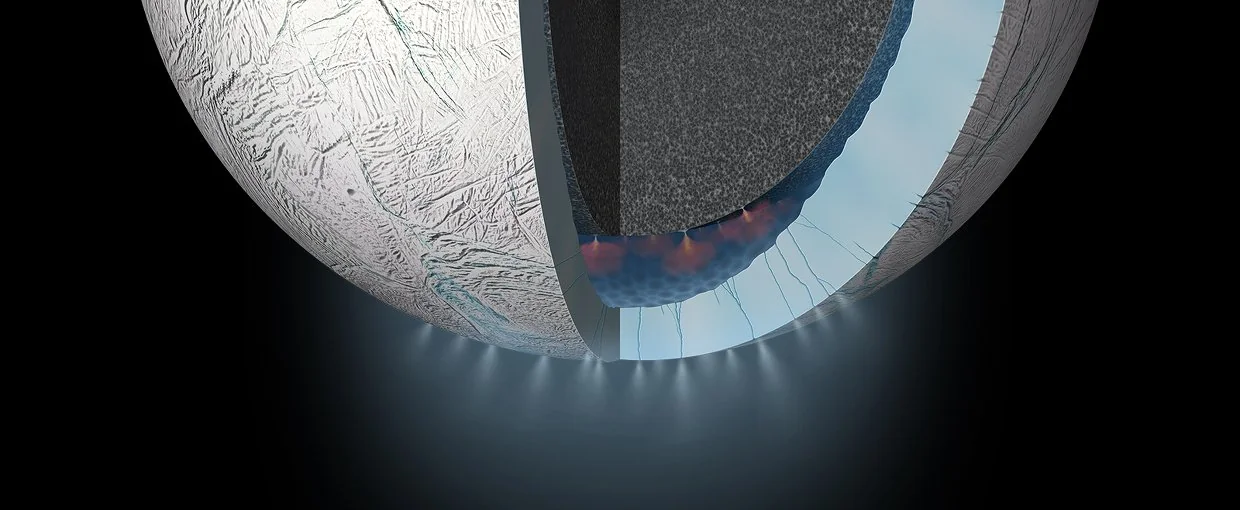
A promising sampling target is not evidence that a world is inhabited.
How should a future mission decide what to examine on an ocean world? That question comes before interpreting a possible sign of life. A useful sample must carry information about its source, and scientists must understand what happened to it along the way.
What did the natron experiment show?
In research published October 6, 2026, Liam J. Perera and colleagues observed fluid pockets inside natron, a hydrated sodium carbonate, while freezing a laboratory solution. X-ray imaging and diffraction followed the process. This was an Earth-based experiment, not a sample collected from Enceladus.
The original paper used a solution about five times more concentrated than estimates from plume-derived particles. The authors caution against transferring crystal textures and inclusion abundance quantitatively to the moon. Microbial preservation in these cryogenic salts remains untested. They propose identifying natron in fresh near-vent deposits as a future sampling priority.
What has a spacecraft actually measured?
NASA/JPL’s June 14, 2023 account describes phosphorus identified in salt-rich ice grains using archived Cassini Cosmic Dust Analyzer data. Researchers examined grains in Saturn’s E ring, which receives material from Enceladus’s plume. That is a spacecraft-based chemical finding, separate from the later natron experiment.
The same account explicitly distinguishes the ingredients needed for life from an inhabited environment. It reports no discovery of life. Cassini ended in 2017: a later analysis of its archive is not a later flyby.
What would a stronger life-search result require?
The NASA-hosted abstract of a 2022 mission-objectives study, led by Shannon M. MacKenzie, proposes complementary measurements of possible biosignatures alongside geochemical and geophysical investigation. The plume could let a successor investigate ocean-derived material without drilling through the ice. This is a mission-concept argument, not confirmation of a funded flight or a life-detection outcome.
Our reading separates three decisions: choose a material worth examining; establish what its measurements reliably show; then test whether biology explains them better than alternatives. Success at the first stage cannot be substituted for success at the last.
This is a different question from our Enceladus fermentation-model review, which examines proposed explanations for plume chemistry. Neither an appealing target nor a model that fits observations automatically establishes an organism. The biosignature evidence guide explores why competing explanations matter.
Review scope and dates
We reviewed the original experiment’s main text and two main figures through the institutional repository, the NASA/JPL account, and the mission study’s repository abstract. We did not review all supplementary material, reproduce the experiment or independently validate its data. This is an explainer of existing research, not an October 17 discovery announcement.
Follow the sources
- Perera and colleagues: natron experiment DOI 10.1038/s43247-026-04080-z; October 6, 2026. Original article-in-press PDF main text and Figures 1–2 reviewed; supplements and data not independently reproduced.
- Publisher: article record Publication date verified through publisher search and subject listing; direct journal-page retrieval unavailable.
- NASA/JPL: Cassini phosphorus finding June 14, 2023 institutional account reviewed; underlying phosphorus paper not independently reviewed.
- NASA NTRS: life-search mission objectives MacKenzie and colleagues; NTRS lists June 8, 2022 publication. Repository abstract and metadata reviewed, not the complete mission-concept paper.
Each source note identifies the context and evidence it supports. Linked material establishes only the claims described in its source note. Official attribution and publication do not eliminate uncertainty. Read our editorial standard.
This is original, AI-assisted research and analysis compiled from the linked sources. It has not received independent expert review. We distinguish source findings from our interpretation and record substantive corrections. Corrections policy