Habitability, a successful model and a detected organism are different claims. This study does not establish life.
A useful question about Saturn’s moon Enceladus is how to move from a chemical measurement to an explanation of its source. The distinction matters whenever an exciting result is described as evidence for an inhabited ocean.
Start with the spacecraft measurement
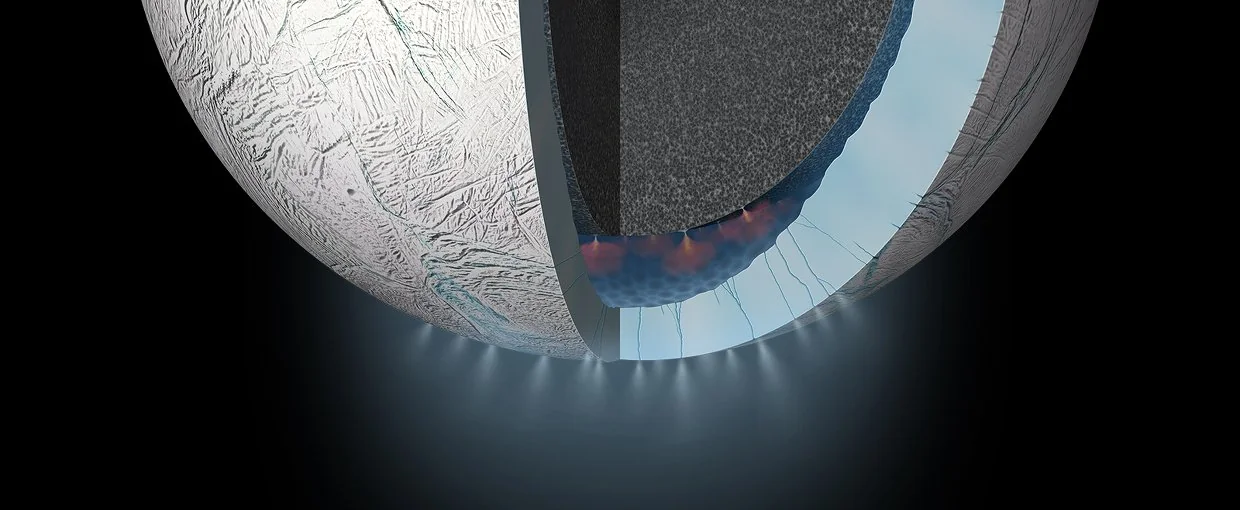
NASA’s April 13, 2017 release reported hydrogen detected by Cassini during its October 28, 2015 passage through the moon’s plume. The instrument sampled escaping gas, rather than observing microbes in the ocean. The finding supported a potential source of chemical energy: hydrogen reacting with carbon dioxide can sustain methane-producing organisms on Earth.
Cassini’s instrument was originally designed to study Titan’s upper atmosphere. NASA explained that the spacecraft had not been designed to detect signs of life in Enceladus’s plume, whose existence was discovered after arrival at Saturn. Those historical observations are the background for later interpretation; an October research paper is not an October spacecraft encounter.
What the new study tests
In a preprint revised October 12, Sam Nasreldine and colleagues model fermentation coupled to methane-producing microbes. Glycine represents fermentable organic material. With sufficient supply, some communities reproduce hydrogen and methane escape rates inferred from Cassini while requiring less hydrogen from rock–water reactions.
The fuel supply remains uncertain. Some successful scenarios require more available organics than the authors infer from asteroid samples. Their statistical comparison ranks four biological community alternatives; it does not compare the probability of life against every nonbiological explanation.
The model assumes approximately steady ocean gas inventories and does not simulate the full journey through ocean and ice fractures. Suggested tests include acetate, ammonium and methane carbon isotopes, interpreted alongside transport effects and abiotic chemistry.
Why chemistry leaves room for competing explanations
A February 8, 2022 NASA Astrobiology feature explained why abundant unused chemical energy does not itself show that an ocean is empty. The properties and turnover of hypothetical organisms could affect how much hydrogen remains. That is an interpretation problem, not an observation of an ecosystem.
For readers, ask two separate questions: can a proposed process produce the measurements, and do the measurements distinguish that process from its competitors? A good answer to the first makes a hypothesis worth testing. It does not automatically answer the second. Our biosignature evidence guide examines the same inferential challenge with different instruments and a different world.
What we reviewed
We inspected the preprint’s original HTML results, discussion and main methods, alongside the two NASA accounts. We did not fully review its supplementary material, reproduce its code or establish journal peer review. This article is a bounded research review; it does not independently validate the simulations.
Follow the sources
- Nasreldine and colleagues: Enceladus fermentation model Preprint: October 9, 2026; revised October 12. Original HTML results, discussion and main methods reviewed; supplementary material not fully reviewed, code not reproduced, journal peer review not established.
- NASA: ocean-world findings, release 17-042 April 13, 2017 report on Cassini hydrogen measurements, including the October 28, 2015 flyby. Historical evidence, not a new observation.
- NASA Astrobiology: interpreting plume chemistry February 8, 2022 feature by Daniella Scalice on Tori Hoehler’s research. Institutional explanation reviewed; underlying Nature Astronomy paper not independently reviewed.
Each source note identifies the context and evidence it supports. Linked material establishes only the claims described in its source note. Official attribution and publication do not eliminate uncertainty. Read our editorial standard.
This is original, AI-assisted research and analysis compiled from the linked sources. It has not received independent expert review. We distinguish source findings from our interpretation and record substantive corrections. Corrections policy