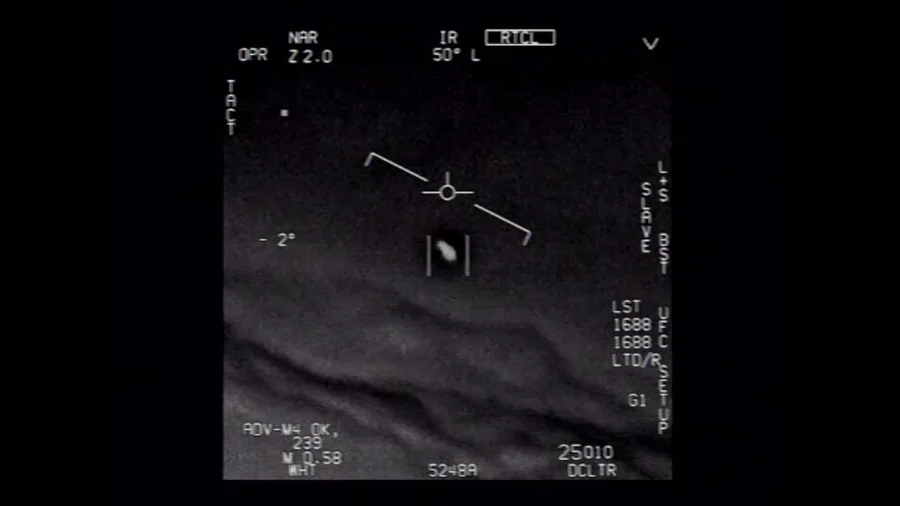
The public record contains witness accounts and an officially released Navy recording. Those are different forms of evidence; they do not establish extraterrestrial origin.
The Nimitz “Tic Tac” case combines a reported visual encounter, a later sensor recording and years of public discussion. The useful starting point is to keep those records separate. This guide explains what each source contributes, where dates can be confused, and what evidence would be needed to test claims about extraordinary performance.
What did David Fravor report seeing?
In his written congressional statement, Fravor described a November 2004 training flight from USS Nimitz redirected by USS Princeton. He said four aircrew saw a white, oblong object above disturbed water. He reported no visible wings or rotors, a climbing maneuver as he descended, and a rapid departure. He identified Alex Dietrich as the other pilot in the flight.
That is an account of a firsthand observation. His statement also recounts information relayed by the ship’s controller about radar contacts. Readers should distinguish what Fravor says he saw from what he says others reported. Our David Fravor profile provides background on his role.
Was Fravor filming the encounter?
The widely shared FLIR recording comes from a later flight. In a December 2019 interview, Chad Underwood described meeting Fravor after Fravor’s flight and subsequently recording a target. Underwood said he was tracking through his instruments and had no direct visual sighting. He also acknowledged that he could not visually confirm the apparent acceleration at the recording’s end.
This distinction matters when a podcast plays FLIR while describing Fravor’s descent. The accompanying footage should not be presented as a recording of that exact visual encounter. A useful claim check asks which flight, witness and instrument support each sentence.
Which dates belong to which records?
The Defense Department’s April 27, 2020 notice authorized release of three unclassified Navy videos: one recorded in November 2004 and two in January 2015. It noted their earlier unauthorized circulation in 2007 and 2017. The authorization date is therefore neither the encounter date nor the first time footage circulated publicly.
The current DVIDS FLIR entry credits Naval Air Systems Command, lists a runtime of 1 minute 16 seconds, and shows March 19, 2025 as its posting date. Its “Date Taken” field reads November 1, 2004. Fravor’s written statement specifies November 2004 without a day. We preserve those differences rather than treating a repository field as proof of an exact encounter date or announcing a fresh incident from a later upload.
What does congressional testimony establish?
The official House hearing record places Fravor alongside Ryan Graves and David Grusch on July 26, 2023. It provides a public setting and a traceable record for their statements. A committee hosting testimony does not convert every asserted interpretation into a verified technical result. Our UAP hearings guide helps readers find the underlying proceedings.
How should speed and acceleration claims be checked?
NASA’s 2023 independent study report emphasizes calibrated sensors, multiple measurements and metadata. It specifically identifies distance as essential to evaluating claims of unusual speed or acceleration. This is a general scientific standard, not NASA resolving the Nimitz case.
Our reading checklist follows that standard: look for synchronized timestamps, target range, aircraft motion, sensor settings and uncertainty estimates. Ask which values were measured and which were assumed. A numerical calculation can be internally correct yet depend on an unverified distance. See our separate GoFast analysis guide for context on apparent motion; conclusions about one video should not automatically be transferred to another.
Does the public evidence establish an alien spacecraft?
No extraterrestrial conclusion follows merely from the existence of an authentic recording or a sincere witness account. NASA’s UAP FAQ says it has not found credible evidence of extraterrestrial life and that UAP have not been established as extraterrestrial. It also explains that its independent study concerned methods for future research, rather than adjudicating earlier incidents.
The productive question is what new, inspectable evidence changes the assessment. When a new interview or document appears, compare its specific contribution with the existing record. More retellings are not automatically more independent observations; a new dataset, attributable witness detail or reproducible analysis deserves a closer look.
Follow the sources
- David Fravor’s written statement to the House Oversight Committee Written testimony for the July 26, 2023 hearing; distinguishes the visual encounter from a later crew’s recording.
- House Oversight: July 26, 2023 UAP hearing Official hearing date, witness list and testimony links.
- Naval Air Systems Command / DVIDS: FLIR – UAP Official video record; 1 minute 16 seconds; repository posting dated March 19, 2025.
- Department of Defense: release of historical Navy videos April 27, 2020 authorization; distinguishes the November 2004 recording from two January 2015 recordings.
- Intelligencer: interview with Chad Underwood December 19, 2019 firsthand interview about recording FLIR; an eyewitness account, not an official technical finding.
- NASA UAP Independent Study Team: final report September 2023; general scientific requirements for calibration, metadata, distance and motion analysis.
- NASA: UAP frequently asked questions NASA’s evidence position and explanation that its study was not a review of past incidents.
Source dates and context are listed below. Linked material establishes only the claims described in its source note. Official attribution and publication do not eliminate uncertainty. Read our editorial standard.
People and the wider public record
Explore the backgrounds and source boundaries behind related public discussions.
Official UAP hearing records ↗This is original, AI-assisted research and analysis compiled from the linked sources. It has not received independent expert review. We distinguish source findings from our interpretation and record substantive corrections. Corrections policy