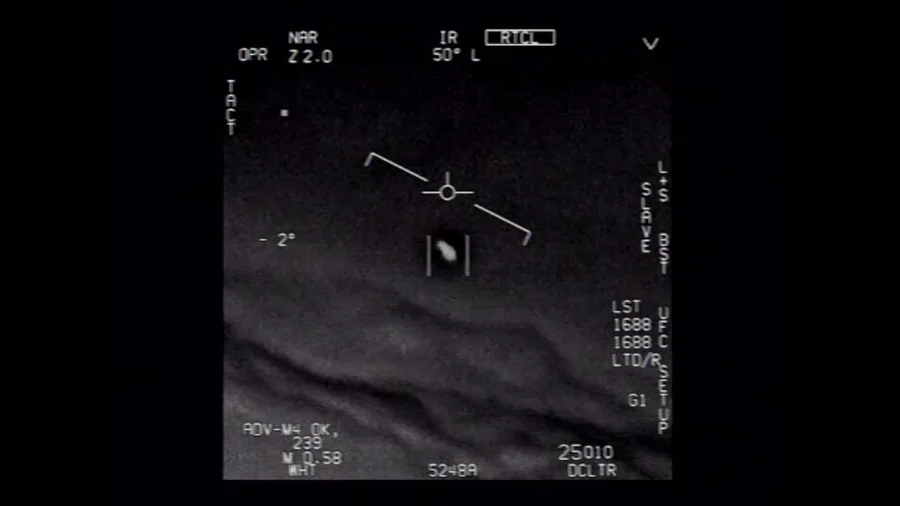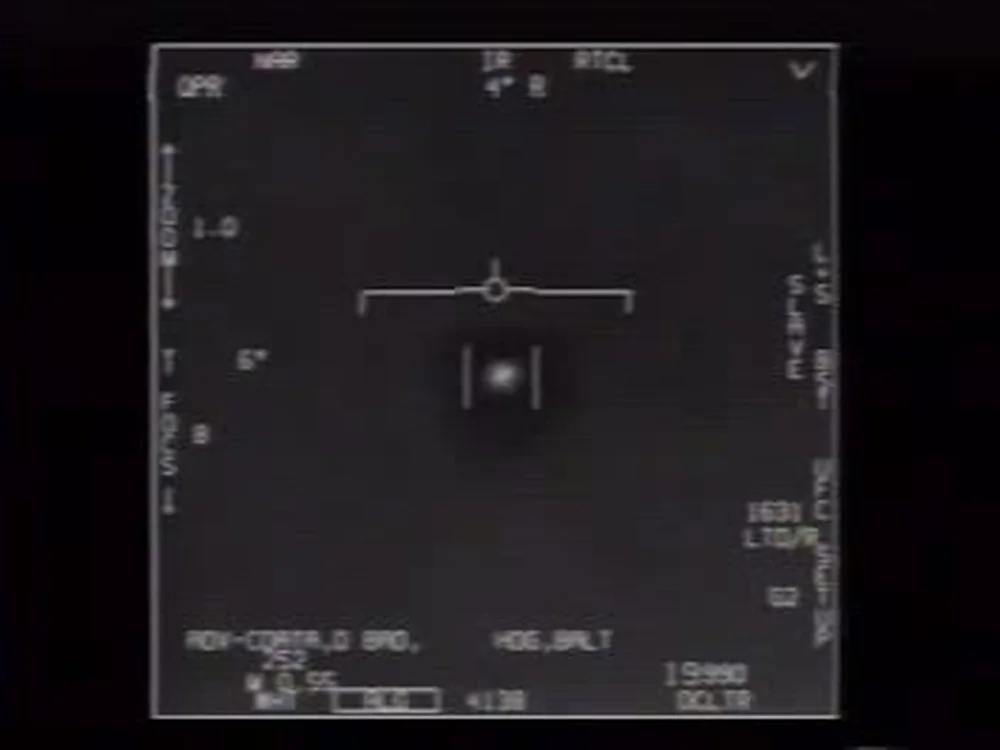
AARO assessed the apparent motion as consistent with parallax and reported no anomalous performance. That is a narrower finding than identifying the object.
The ocean appears to race behind a small target. The first impression is speed. The scientific question is how much of that impression comes from the target and how much comes from the aircraft carrying the camera.
Start with the observer’s motion
Motion parallax is familiar from a moving car: a nearby roadside object sweeps across the view while a distant hill appears to move slowly. Estimating an airborne object’s behavior also requires the camera’s position and motion, its viewing angle, distance to the target, and the background used as a reference.
AARO’s February 2025 analysis assessed the GoFast target as roughly 13,000 feet above the ocean. The office found that parallax accounted for the striking apparent speed and expressed high confidence that the footage showed no anomalous performance.
Identification and performance are separate questions
The assessment did not definitively establish what the object was. Calling it a confirmed balloon, bird or drone would overstate that result. Likewise, an uncertain identity does not erase the value of estimating motion. Investigators can constrain one property while another remains unknown.
AARO’s methodology evaluates different wind and heading scenarios. A speed range produced under those assumptions should not be reduced to a single uniquely measured speed. The assumptions are part of the result.
What the government’s release established
On April 27, 2020, the Department of Defense authorized the release of three unclassified Navy videos, one recorded in November 2004 and two in January 2015. The release addressed uncertainty about the footage’s authenticity. It did not certify an extraterrestrial explanation.
GoFast is one case. Its analysis should not be silently applied to GIMBAL, FLIR, or every account associated with those recordings. Each claim needs its own data and its own assessment. The official GoFast player below allows readers to compare the familiar clip with the linked methodology.
Watch the original source
Follow the sources
- AARO GoFast case resolution and methodology (PDF) February 6, 2025; analysis and uncertainty assumptions
- Official release of historical Navy videos April 27, 2020; provenance of the three released videos
Source check: October 12, 2026. Linked material establishes only the claims described in its source note. Official attribution and publication do not eliminate uncertainty. Read our editorial standard.
People and the wider public record
Explore the backgrounds and source boundaries behind related public discussions.
Official UAP hearing records ↗This is original, AI-assisted research and analysis compiled from the linked sources. It has not received independent expert review. We distinguish source findings from our interpretation and record substantive corrections. Corrections policy