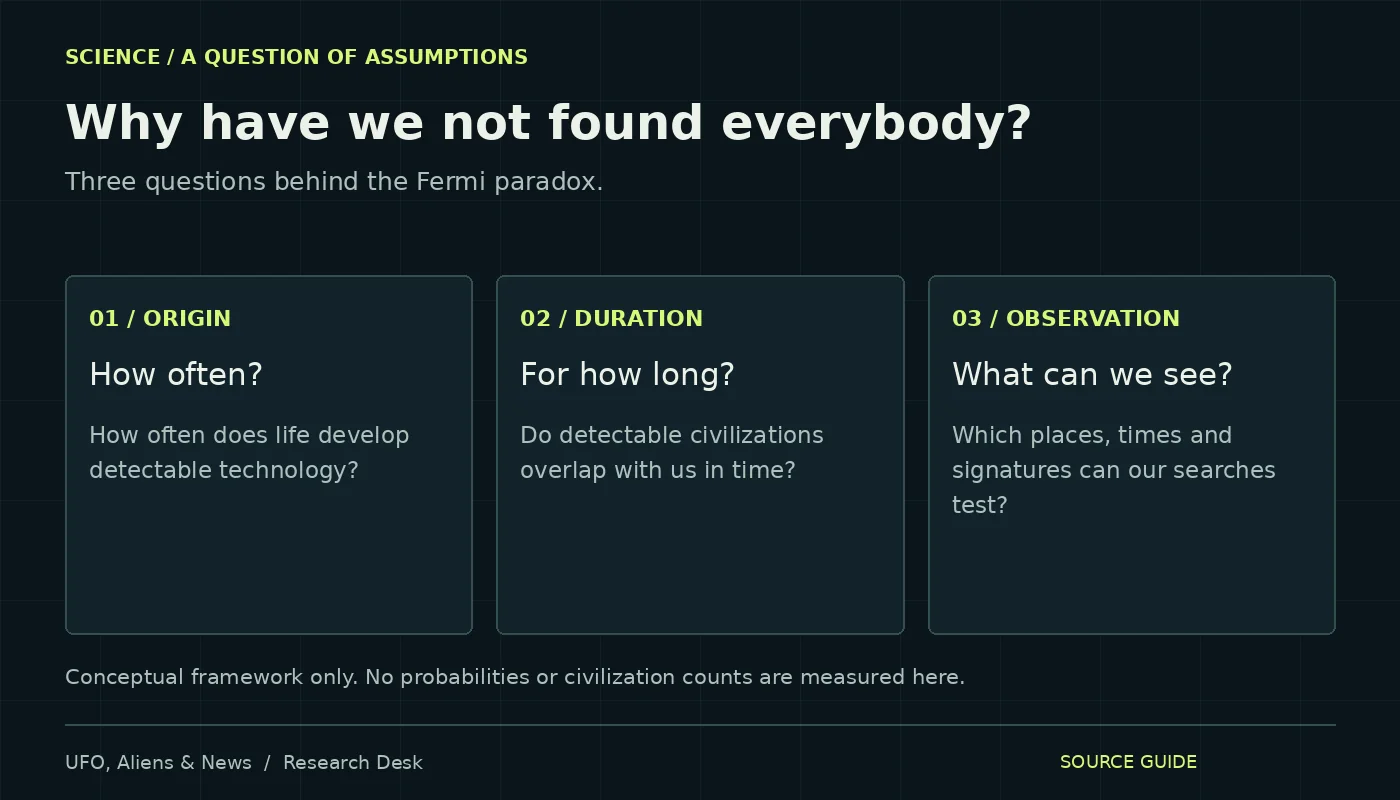
The Fermi paradox is a tension between expectations and observations. It does not establish that civilizations are common, that every civilization would expand, or that a particular explanation is correct.
The Fermi paradox asks why we have no confirmed evidence of extraterrestrial civilizations if the galaxy offers enough places and time for some to arise and spread. The SETI Institute’s introduction describes that apparent mismatch. The word “if” matters: the argument combines observations with assumptions about biology, technology, survival and expansion.
Is it a proof that aliens do not exist?
No. A prediction follows from its premises. If expected evidence is absent, we must examine those premises and whether the search could have found the evidence. Microbial life, a distant technological society and travelers reaching Earth are different claims. An argument about travelers cannot settle every form of life.
Robert H. Gray also distinguishes Fermi’s remembered question from later formal arguments. We use the familiar name for the scientific discussion, without treating a reconstructed lunch conversation as a published theorem.
Which assumption does an explanation change?
| Proposed explanation | Premise it changes | Useful evidence to seek |
|---|---|---|
| Life or technology is uncommon | Many suitable worlds produce detectable civilizations. | Independent examples of biology; carefully bounded searches for technology. |
| Detectable phases are short | Other societies overlap with us in time. | Signals or artifacts with a measurable lifetime; limits under explicit lifetime models. |
| Expansion is limited or uneven | Travelers eventually occupy every suitable system. | Models that state travel range, settlement lifetime and which systems are suitable. |
| Our searches miss the relevant signature | Existing observations would reveal the proposed technology. | Survey sensitivity, targets, frequencies, observing times and detection methods. |
This framework keeps an explanation testable. A claim that someone is deliberately hiding can accommodate almost any non-detection unless it also makes a discriminating prediction. A compelling narrative alone is not a measurement.
Have we searched enough to call the galaxy silent?
Wright, Kanodia and Lubar’s radio-search analysis shows why “we looked” is incomplete. Coverage depends on direction, distance, sensitivity, frequency, bandwidth, observing time and the kinds of signals an analysis can recognize. Their model found that the programs assessed had searched a very small fraction of a defined possibility space.
The paper’s historical calculation is not a current percentage of the universe searched. Its durable lesson is methodological: define the target before interpreting a null result. More observing improves constraints, but a radio survey does not test every possible biosignature, artifact or communication system.
Would a settled galaxy necessarily include Earth?
Carroll-Nellenback and colleagues’ settlement model includes stellar motion, limited travel and finite settlement lifetimes. Some modeled conditions allow inhabited and uninhabited regions to coexist. This demonstrates that an inference depends on its assumptions; it does not show that any region is actually inhabited.
What can we learn next?
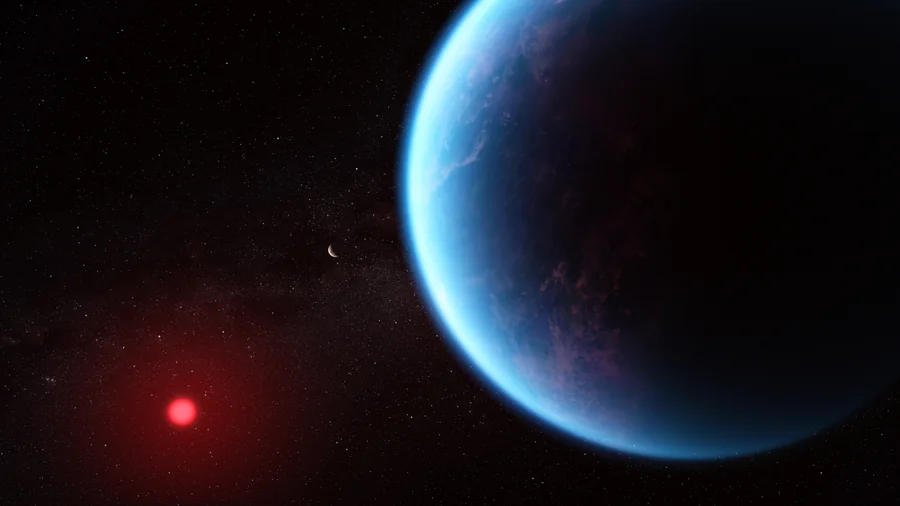
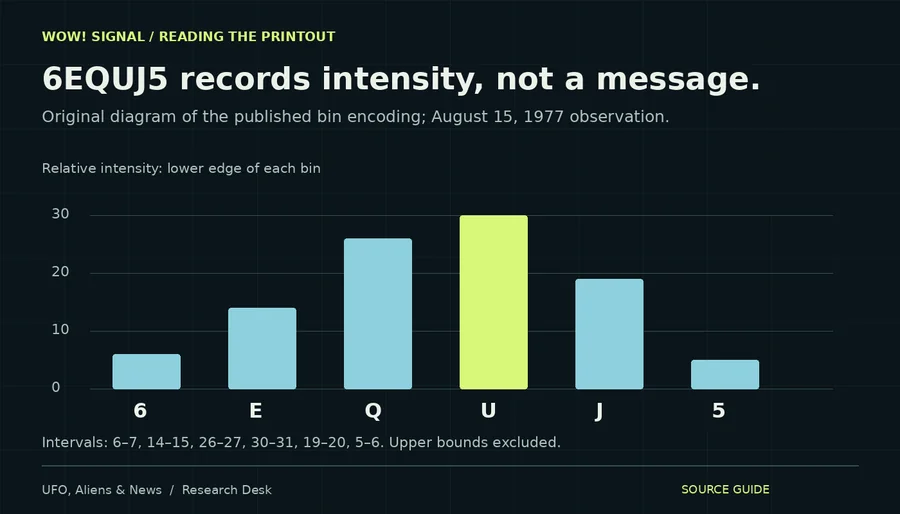
Ask a narrower question with a measurable answer: what type of signal could a survey detect, from which targets, and during which observations? Our K2-18 radio-search guide offers a concrete example. Compare that with the Wow! signal, where an observation exists but its cause remains uncertain. Neither silence nor an unresolved event supplies the missing confirmation by itself.
Explore all alien and UFO questions ↗
Follow the sources
- SETI Institute: the Fermi paradox Institutional introduction to the argument and proposed explanations; reviewed October 27, 2026. Hypotheses are not observations of civilizations.
- Wright, Kanodia and Lubar: How Much SETI Has Been Done? 2018 Astronomical Journal paper; author version revised July 18, 2020. Search dimensions, boundaries and completeness discussion reviewed. Its historical calculation is not a current 2026 coverage estimate.
- Carroll-Nellenback and colleagues: the Aurora effect 2019 Astronomical Journal paper; author version revised February 5, 2020. Settlement model and its stated assumptions, not evidence that settlement has occurred.
- Robert H. Gray: The Fermi Paradox Is Neither Fermi’s Nor a Paradox 2015 Astrobiology article, author manuscript posted in 2016. Abstract reviewed for the distinction between Fermi’s question and later formal arguments; not a review of Fermi’s original conversation.
Each source note identifies the context and evidence it supports. Linked material establishes only the claims described in its source note. Official attribution and publication do not eliminate uncertainty. Read our editorial standard.
This is original, AI-assisted research and analysis compiled from the linked sources. It has not received independent expert review. We distinguish source findings from our interpretation and record substantive corrections. Corrections policy