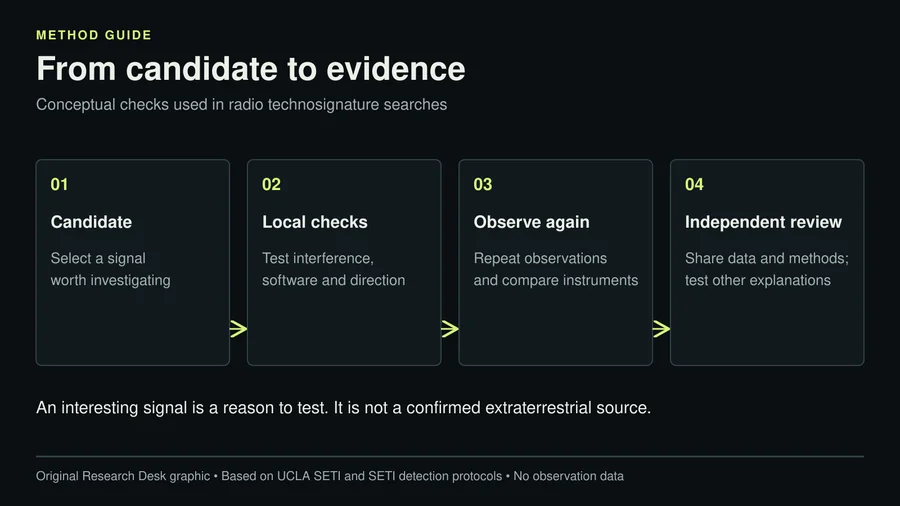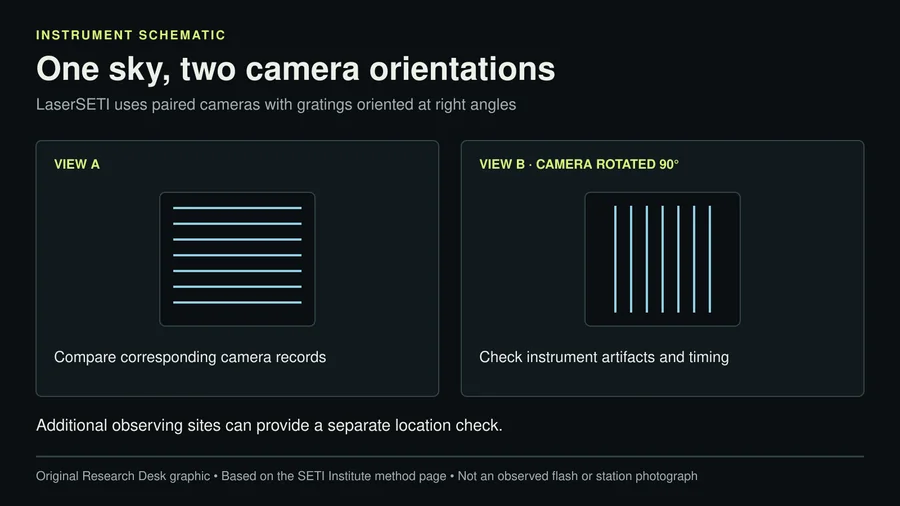
No technosignature was found; the result applies only to this pilot’s tested conditions.
SETI Institute researchers tested whether the point in the sky directly opposite the Sun could be a predictable place and time for another civilization to transmit. Their pilot found no signal that qualified as extraterrestrial technology. This is a search-method result and non-detection, not evidence of alien contact.
The campaign preprint applies the game-theory concept of a Schelling point, where parties unable to coordinate might independently choose the same meeting point. A distant observer aligned with Earth's orbit could see Earth transit the Sun. At mid-transit, a hypothetical transmitter would appear from Earth in the anti-solar direction.
The pilot used 20 Allen Telescope Array antennas for about 17 hours over three nights in summer 2023, producing roughly 32 terabytes of data. The institute says the analysis began with about 1.9 million radio detections. After filtering, all were consistent with human interference.
Under the stated assumptions, the observations could detect an Arecibo-class transmitter out to roughly 124 light-years. That limit applies only to the tested frequencies, times, transmitter power and method. It does not rule out weaker, intermittent, differently aimed or otherwise untested signals.
The related ongoing campaign uses a broader observing and analysis program. A separate primary preprint reports 126 observing sessions and 25 selected spectrograms across 10 coordinates scheduled for re-observation. These are signals of interest, not established technosignatures.
What did we review?
The pilot figures come from the SETI Institute's November 3 release. The named journal article and its full data were not independently inspected. The separate October campaign preprint supplies only the continuing-survey context. For the evidence steps that should follow any candidate, read our alien-signal verification guide.
Follow the sources
- SETI Institute: When Should We Listen for Alien Signals? Institutional release dated November 3, 2026. It reports the anti-solar-point pilot design, conditional sensitivity and non-detection. The named journal article and its full data were not independently inspected.
- Gerrard and Sheikh: A Technosignature Survey Of The Anti-Solar Point: The SETI Institute’s Largest-Ever Campaign With The Allen Telescope Array Primary preprint submitted October 5, 2026. Its ongoing campaign, selected spectrograms and planned re-observations are separate from the pilot result described in the institutional release; full-paper review was not repeated for this brief.
Each source note identifies the context and evidence it supports. Linked material establishes only the claims described in its source note. Official attribution and publication do not eliminate uncertainty. Read our editorial standard.
This is original, AI-assisted research and analysis compiled from the linked sources. It has not received independent expert review. We distinguish source findings from our interpretation and record substantive corrections. Corrections policy