The SETI Institute reports that two AlUla LaserSETI stations are commissioned and collecting data. This expands the search network; it does not report a signal, candidate technosignature or evidence of alien life.
Two LaserSETI stations at AlUla Manara in northwest Saudi Arabia are now commissioned and collecting astronomical data, according to an October 22 SETI Institute release. The institute calls AlUla the network’s first observing site in Asia and its fifth site worldwide.
The release reports an August 19 installation date. Those dates describe different milestones: installation occurred in August; the operational announcement arrived in October. Neither date marks a detected signal.
What changed at AlUla?
The institute says the two stations are fully operational and actively collecting data. It lists the other sites in California, Hawai‘i, Arizona and Puerto Rico. Under the announced arrangement, the SETI Institute will operate and maintain the AlUla installation with the Royal Commission for AlUla for three years.
This is an institution-reported commissioning milestone. We did not receive station telemetry, an observing log or an independent commissioning report, so the operational status remains attributed to the institute rather than presented as our own technical verification.
How does the optical search work?
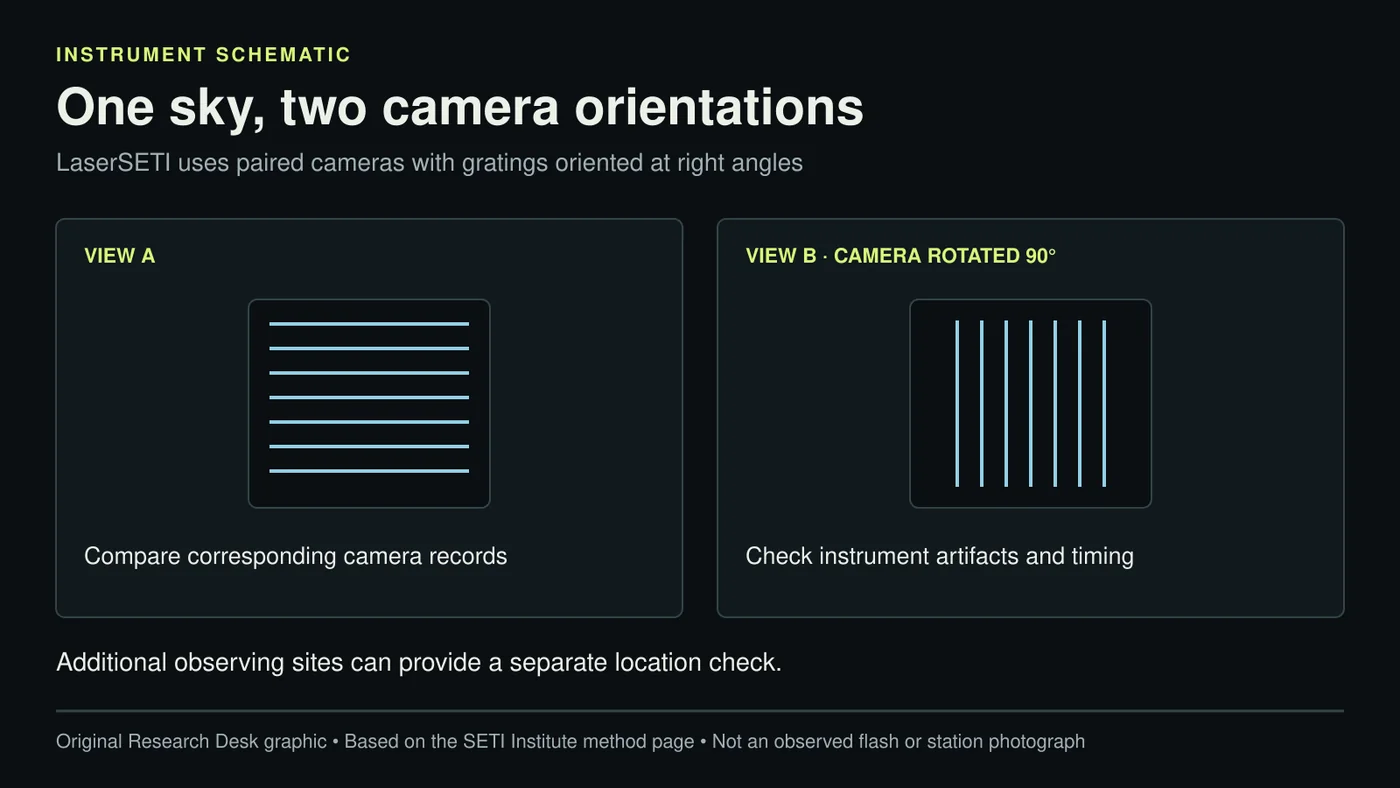
The project overview describes wide-field cameras fitted with diffraction gratings. A grating spreads incoming light into a spectrum. A very brief, narrow optical flash can therefore leave a recognizable pattern across the detector instead of appearing only as one bright point.
LaserSETI pairs cameras with their gratings rotated by 90 degrees. Comparing the two views is intended to help distinguish a real sky event from a detector artifact. Multiple observing sites can add a separate location check, but more instruments do not make every flash artificial or extraterrestrial.
Why add another observing location?
A geographically distributed network can watch more of the sky across more local nights and can compare events seen from different locations. The October release specifically presents AlUla’s dark-sky conditions and position in Asia as additions to the existing network.
Coverage is capability, not discovery. A station becoming operational raises the amount of observing the project can attempt; it does not by itself establish the sensitivity achieved, the uptime delivered or the number of credible candidates found.
What this announcement does not say
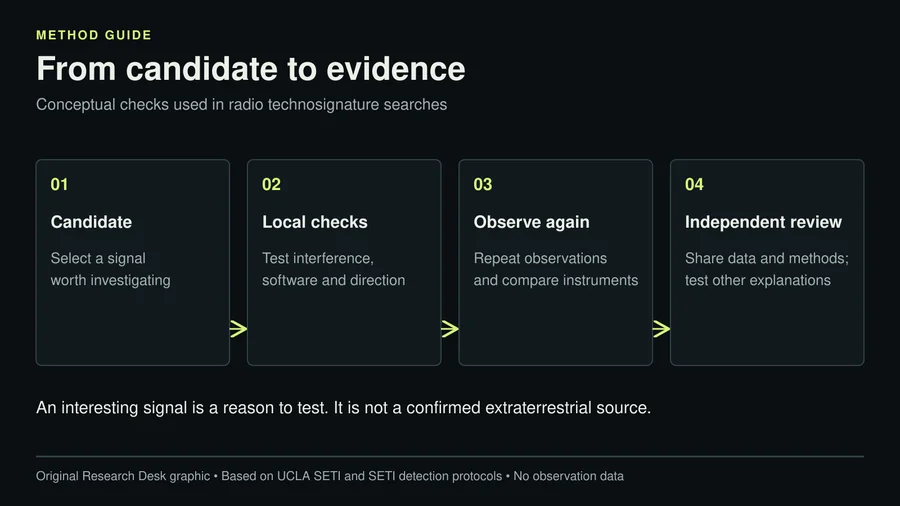
The release does not report a detected technosignature. Brief optical changes can come from ordinary astronomical transients, objects in or near Earth orbit, atmospheric effects, aircraft, instrumental artifacts or other sources. A candidate would require checks for repeatability, timing, instrument behavior and independent observations before an extraordinary interpretation could be justified.
Our SETI verification guide explains the broader evidence ladder: an instrument trigger, a surviving candidate and a confirmed extraterrestrial signal are not interchangeable stages. LaserSETI’s method differs from a radio-telescope search, but the need for repeatable evidence and alternative-explanation checks remains.
What evidence should come next?
Useful next records would include observing uptime, calibrated sensitivity, candidate-screening methods, cross-site comparisons and peer-reviewed results. If the project publishes a candidate, the important questions will be what the instruments recorded, which ordinary explanations were tested, whether another station saw it and whether independent observers can repeat or corroborate the event.
We reviewed the written October 22 release, the project-method page and the August 2024 partnership announcement. We did not review raw station data, software, a live feed or an independently audited performance report. The institute’s station photograph was not reproduced because a reusable image license was not established.
Follow the sources
- SETI Institute: LaserSETI stations in Saudi Arabia October 22, 2026 institutional release reviewed. It reports two AlUla stations are commissioned and collecting data after an August 19 installation. No underlying telemetry, candidate event or independent commissioning record was provided.
- SETI Institute: LaserSETI project overview Current project-method page reviewed October 22, 2026. General camera, diffraction-grating and paired-station design description; older deployment language is not treated as current status.
- SETI Institute: Royal Commission for AlUla collaboration August 8, 2024 partnership announcement reviewed as planning history, not evidence that commissioning had occurred then.
Each source note identifies the context and evidence it supports. Linked material establishes only the claims described in its source note. Official attribution and publication do not eliminate uncertainty. Read our editorial standard.
This is original, AI-assisted research and analysis compiled from the linked sources. It has not received independent expert review. We distinguish source findings from our interpretation and record substantive corrections. Corrections policy