The object, its dimensions and discovery are documented. A wax forming experiment shows one practical use is mechanically plausible, but the original Roman purpose remains uncertain.
A small bronze object with circular openings and knobs can resemble a mechanical fitting. The Roman dodecahedron in Tongeren is a useful case because its existence, dimensions and museum identity are secure while its function remains uncertain. Keeping those two findings together avoids turning a real gap in knowledge into a claim of alien machinery.
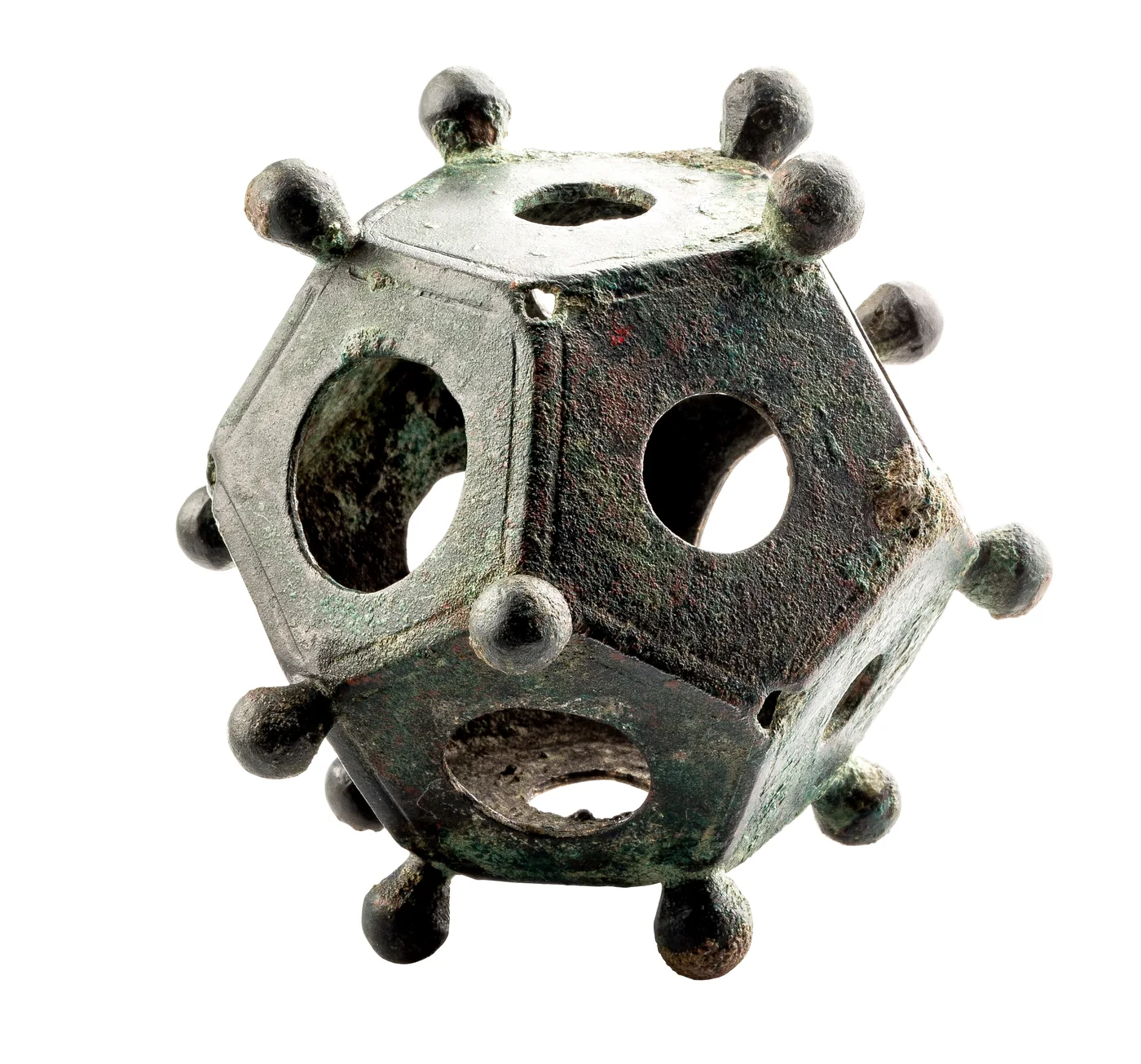
Which dodecahedron is pictured?
The museum supplied image record identifies inventory 4002, found at Leopoldwal in Tongeren in 1939. The museum's collection book, pages 172 to 173, dates the bronze object to 150 to 400 CE and gives its height as 8.1 cm. It is therefore approximately 1600 to 1900 years old, rather than an object with one established manufacture year.
The museum's current account distinguishes it from a second object's fragment discovered in Overrepen in 2021 and donated in June 2023. Those later dates must not replace the discovery history of the nearly complete object shown here.
What does the museum think?
Roman examples have twelve pentagonal faces, circular openings and knobs at twenty corners. The museum reports no surviving ancient written explanation of their use. It questions standardized practical interpretations because dimensions and opening proportions vary, and it discusses possible religious significance, including comparison with an example mounted on a staff in a burial.
That is an attributed interpretation, not a settled answer for every dodecahedron. Variation can challenge a proposed measuring system without proving that every practical use was impossible. The burial comparison provides context, but it does not turn the Tongeren object's particular history into a known ritual biography.
What did the wax forming experiment show?
A May 2026 experimental archaeology study tested whether the shape could help form wax seals or tokens. Researcher Greg Lamb used a representative printed replica rather than a copy of the Tongeren object. He pressed softened wax around cord and found that the corner knobs limited compression, the openings helped release the wax, and the tool produced an ordered form with a raised center.
Ten tokens made in one session without cord or knots had measured edge thicknesses of approximately 4.0 to 4.5 mm. Those trials isolated thickness control from the separate cord attachment tests. The study calls that a preliminary result because it used a steel rule rather than callipers. It also used one maker, a small number of replicas, cotton cord and modern stand ins for seal impressions. A similar wax form could be made by hand. The experiment therefore shows that wax forming is mechanically plausible under the tested conditions. It does not show that Roman people used this object that way, or that every dodecahedron had the same purpose.
How could competing explanations improve?
A functional proposal should predict features beyond appearance: a particular pattern of wear, consistent relationships between openings or a recurring archaeological context. A replica demonstration can test whether a proposed task is possible. It cannot by itself show that Roman people performed that task with the surviving object.
The photograph and the 8.1 cm measurement establish a physical artifact. A modern machine fitting remains an analogy. The sources reviewed here leave the original purpose open and provide no evidence of extraterrestrial manufacture.
Read the comparison carefully
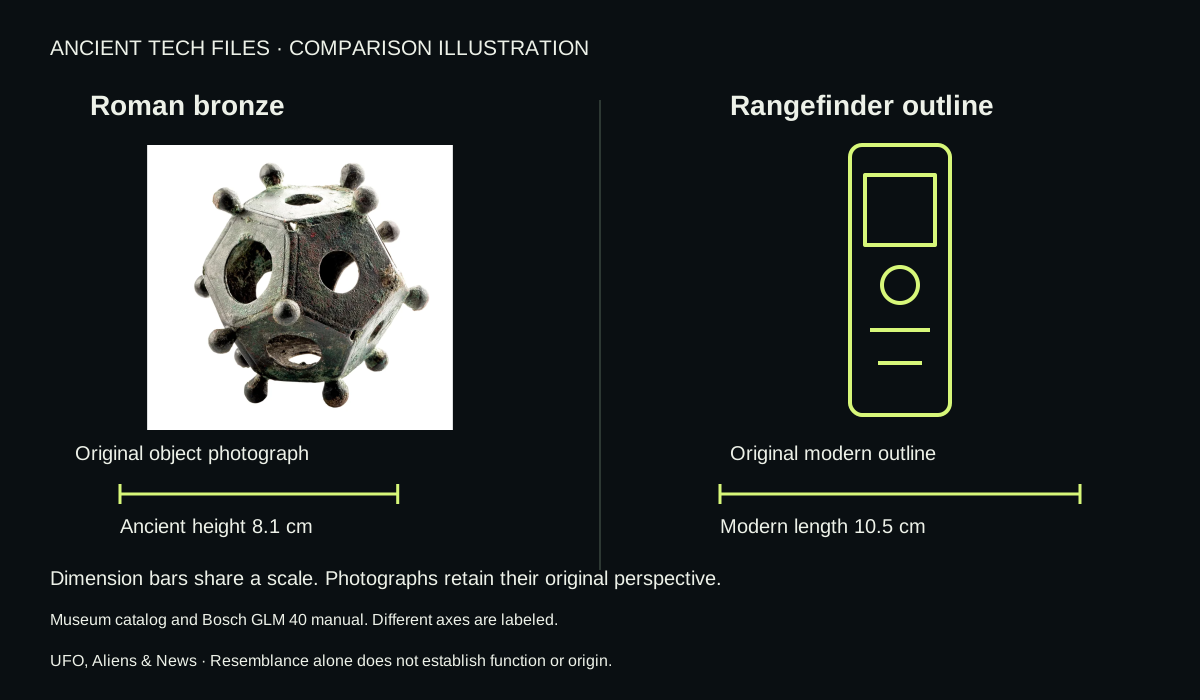
The original diagram compares the Roman object’s cataloged height of 8.1 cm with a modern rangefinder length of 10.5 cm. Those are different labeled axes. Shared dimensional scale does not establish a shared purpose; the rangefinder outline is an editorial comparison.
Explore all seven Ancient Tech Files. A matching published Short has not yet been linked. These source pages can be read independently of a video.
Follow the sources
- Gallo Roman Museum: a fragment of a dodecahedron Undated museum account, checked November 15, 2026; distinguishes the object found in 1939 from a fragment discovered in 2021 and donated in June 2023.
- Gallo Roman Museum: 100 key pieces, one hundred stories Museum collection volume, pages 172 to 173; Tongeren bronze dodecahedron dated 150 to 400 CE, height 8.1 cm. Publication date not independently established.
- Gallo Roman Museum: object 4002 photograph and license Commons upload December 2, 2019; photograph date unstated. CC0 1.0 permission recorded through Wikimedia VRT ticket 2019121210005361.
- Greg Lamb: A Functional Reassessment of Roman Dodecahedra as Tools for Forming Standardised Wax Objects Reviewed article in EXARC Journal issue 2026/2, published May 29, 2026. The experiment used a representative printed replica, wax mixtures and ten rapid token trials. It tests mechanical plausibility rather than original Roman intent.
- Bosch: GLM 40 manual July 2020; dimensions 105 by 41 by 24 mm. Only dimensional facts inform the original outline.
Each source note identifies the context and evidence it supports. Linked material establishes only the claims described in its source note. Official attribution and publication do not eliminate uncertainty. Read our editorial standard.
This is original, AI assisted research and analysis compiled from the linked sources. It has not received independent expert review. We distinguish source findings from our interpretation and record substantive corrections. Corrections policy