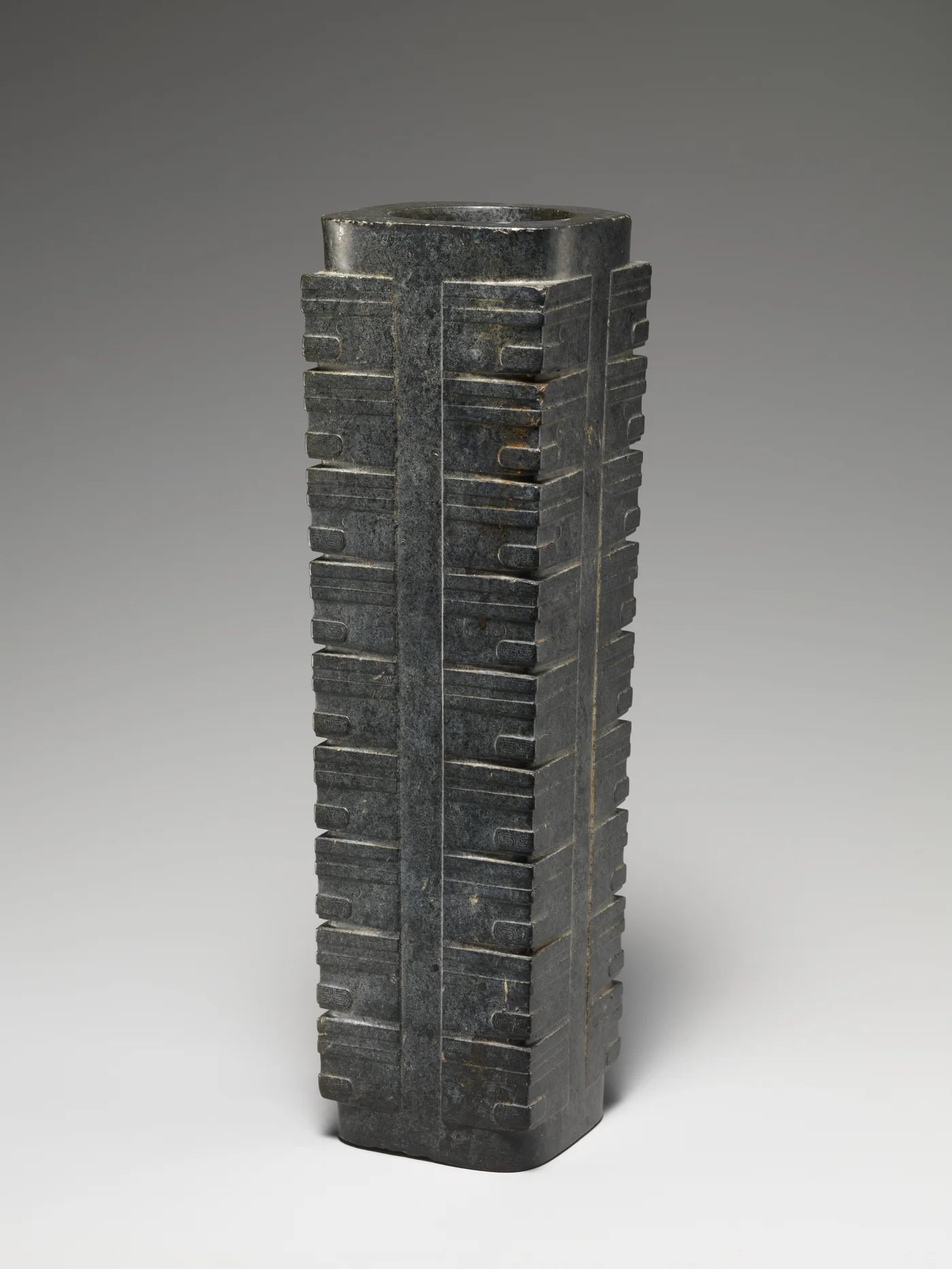
The object demonstrates skilled jade working in Liangzhu culture. Its precise ritual meaning remains uncertain, and the circular bore does not establish an industrial function.
This jade cong is an ancient carved object associated with China's Liangzhu culture. Its geometric form is documented, but its original meaning is not fully understood. The circular opening should be considered alongside the exterior decoration and archaeological tradition, rather than treated as a machine fitting in isolation.
What does the collection record establish?
The Met catalog dates this nephrite object to about 2400 BCE. It is 25.4 cm tall and 7 cm wide. A circular bore passes through a tapering square exterior with abstract masks at the corners. The museum suggests a connection with wealth and status while acknowledging uncertainty about function and meaning.
The acquisition number is 2004.52, and the collection purchase occurred in 2004. That modern date is separate from the object's approximate age. The reviewed entry does not provide an excavation narrative that would let us reconstruct this particular cong's original placement.
How could jade be worked?
The museum's essay on Neolithic China explains that jade was shaped through abrasion with coarse sand. Its hardness made that work demanding. Fine lines and polished surfaces therefore preserve evidence of patient craft rather than proof that the material could not be worked by people.
The essay also discusses jade in elite burials. That broader context helps explain why scholars consider ceremonial and social meanings. It does not establish that this museum object was excavated from a particular tomb, nor does it supply the words its maker used to describe it.
Could the bore be a bearing or pipe?
Theory: the opening served an industrial purpose such as carrying a moving shaft or conveying material. A useful test would ask whether its internal surface, dimensions and wear fit that proposed task. It would also ask what connected to it and whether similar objects occur with the necessary equipment.
A photograph cannot answer those questions. Square outside and circular inside is a description shared by many possible designs. Selecting one modern resemblance does not explain the masks, the investment in jade or the object's cultural setting. A convincing interpretation needs to account for those observations together.
What remains uncertain?
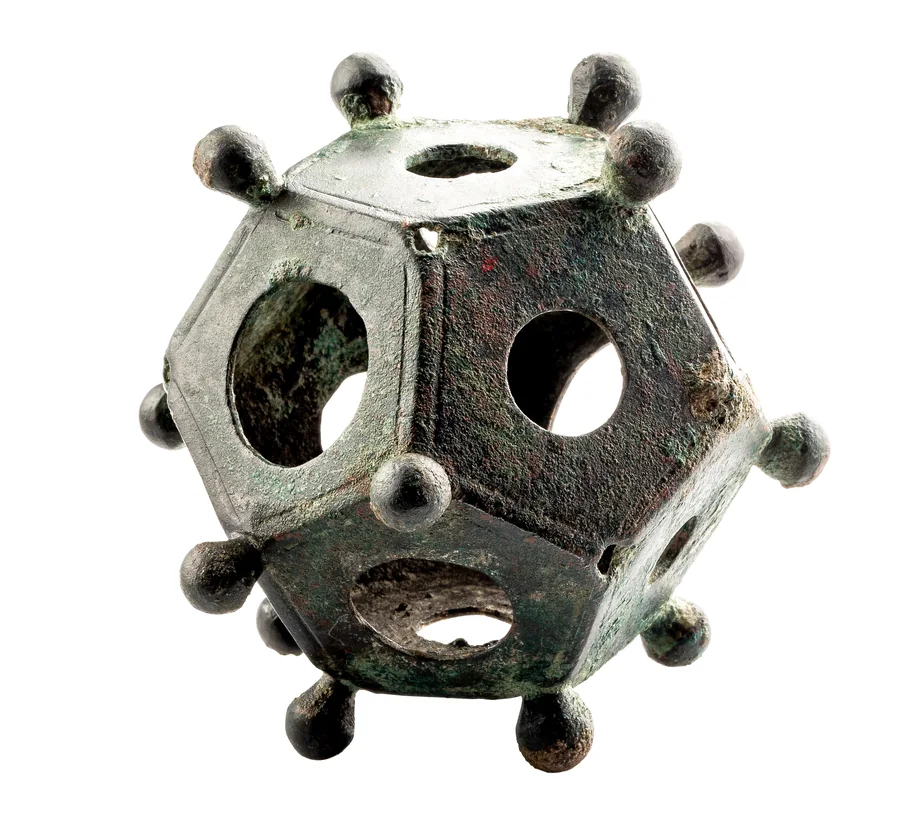
Calling the cong a ritual object is a scholarly interpretation, not a recovered instruction manual. Its significance can remain open without making every alternative equally supported. The record establishes human craftsmanship and a Liangzhu attribution; it does not establish extraterrestrial manufacture. Compare the Roman dodecahedron for another case where a secure object record and an uncertain function must be kept separate.
Follow the sources
- The Metropolitan Museum of Art: ritual object cong 2004.52 Undated collection catalog and complete displayed audio transcript checked November 15, 2026. Liangzhu attribution, approximate object date and qualified function verified. Photograph marked Public Domain.
- The Metropolitan Museum of Art: Neolithic Period in China Department of Asian Art, October 1, 2004. Essay reviewed for jade abrasion and burial context; general cultural evidence is distinguished from this object's individual provenance.
- The Metropolitan Museum of Art: image resources Open Access policy and individual Public Domain object labels checked November 15, 2026. Saved API records for all seven objects additionally report isPublicDomain as true.
Each source note identifies the context and evidence it supports. Linked material establishes only the claims described in its source note. Official attribution and publication do not eliminate uncertainty. Read our editorial standard.
This is original, AI assisted research and analysis compiled from the linked sources. It has not received independent expert review. We distinguish source findings from our interpretation and record substantive corrections. Corrections policy