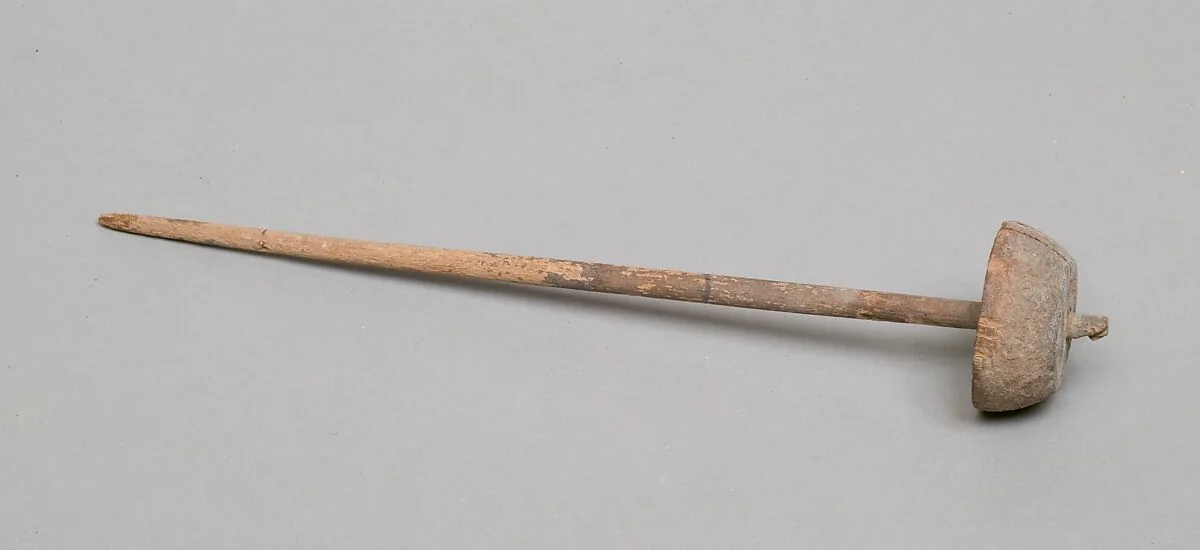
The catalog identifies a textile tool. A whorl helps maintain rotation, making a flywheel analogy useful without establishing a powered engine or alien technology.
A shaft carrying a circular weight can resemble part of a modern machine. In this case, the museum supplies a specific identification: a spindle with a whorl. The resemblance is useful because it leads to a practical question about rotation, rather than a requirement to invent an unknown engine around the object.
A named object from Lisht North
The Met's catalog for accession 22.1.629 identifies wood as the material and gives an approximate date of 1300 to 1080 BCE, during the Ramesside period. It records the cemetery at Lisht North as the origin and associates the object with the museum's excavations. The 1922 acquisition credit is not presented here as a verified excavation date.
The catalog gives the whorl a diameter of 5 cm. Its separate spindle length entry is difficult to reconcile with the proportions visible in the published photograph. We have not resolved that discrepancy and do not use it to build a measured reconstruction of the entire shaft. This is a limit in our review, not a corrected museum measurement.
What does a whorl do?
The museum explains the general function in its entry for a separate spindle whorl from Nishapur: the weight helps maintain the spindle's momentum during thread production. That source concerns a medieval Iranian object. We use its functional explanation, while keeping its date and excavation history separate from the Egyptian spindle pictured here.
The flywheel comparison concerns a shared mechanical idea: a rotating mass helps sustain motion. It is not a claim that the Egyptian artifact belonged to a motor, or that a modern flywheel's material, speed and load can be assigned to it. A useful comparison explains a principle while preserving those differences.
What the record does not establish
The object page does not provide the name of its maker, the identity of its last user or measurements of its original operating speed. Those details should remain blank instead of becoming a dramatic reconstruction. No extraterrestrial manufacturing evidence appears in the records reviewed here.
The documented identification makes the object valuable on its own terms. Textile production required tools that converted controlled motion into useful work. This spindle connects ancient technology with a recognizable mechanical principle, without turning an everyday human craft into evidence of an unsupported origin story.
Read the comparison carefully
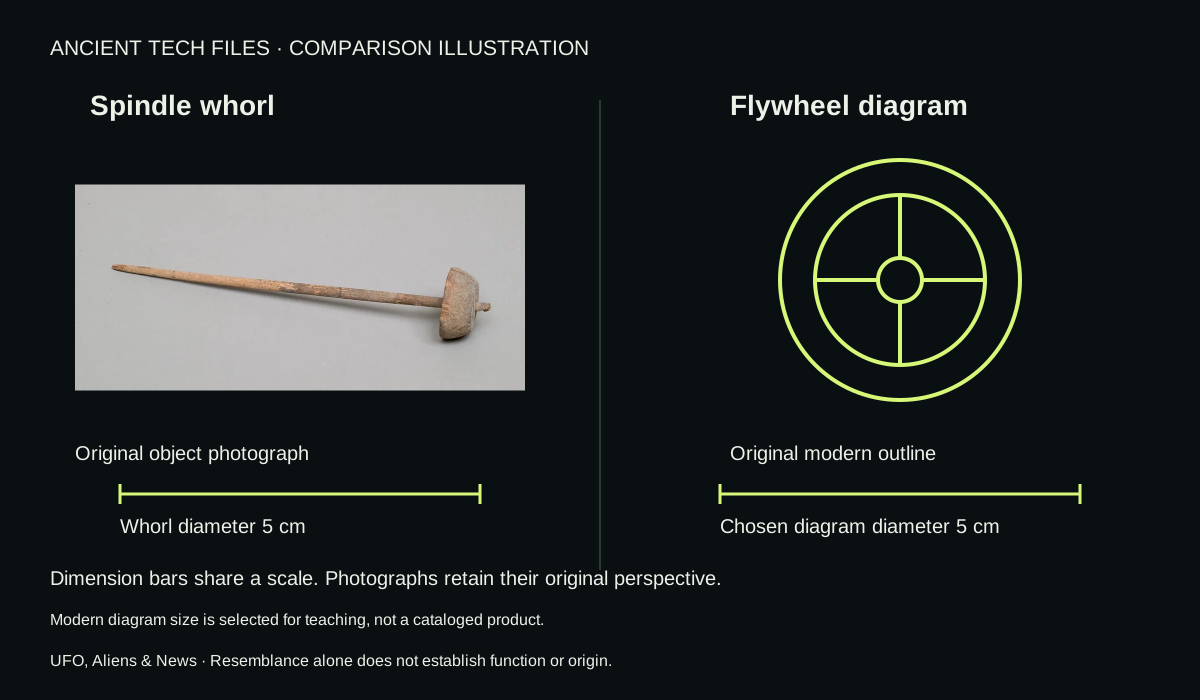
The flywheel diagram is drawn at a chosen diameter of 5 cm to match the published whorl diameter. It is a teaching illustration, not a cataloged modern product or an excavated engine. The comparison concerns rotational inertia, while the object’s archaeological identification remains a spindle.
Explore all seven Ancient Tech Files. A matching published Short has not yet been linked. These source pages can be read independently of a video.
Follow the sources
- The Metropolitan Museum of Art: spindle with whorl 22.1.629 Undated catalog checked November 15, 2026; approximately 1300 to 1080 BCE, wood, Lisht North cemetery. Photograph is public domain.
- The Metropolitan Museum of Art: spindle whorl 40.170.356 Undated catalog checked November 15, 2026; explains how a whorl maintains spindle momentum. This separate object is from medieval Nishapur, not ancient Egypt.
- The Metropolitan Museum of Art: image resources Open Access image policy; object pages used here explicitly mark their photographs Public Domain. Checked November 15, 2026.
Each source note identifies the context and evidence it supports. Linked material establishes only the claims described in its source note. Official attribution and publication do not eliminate uncertainty. Read our editorial standard.
This is original, AI assisted research and analysis compiled from the linked sources. It has not received independent expert review. We distinguish source findings from our interpretation and record substantive corrections. Corrections policy