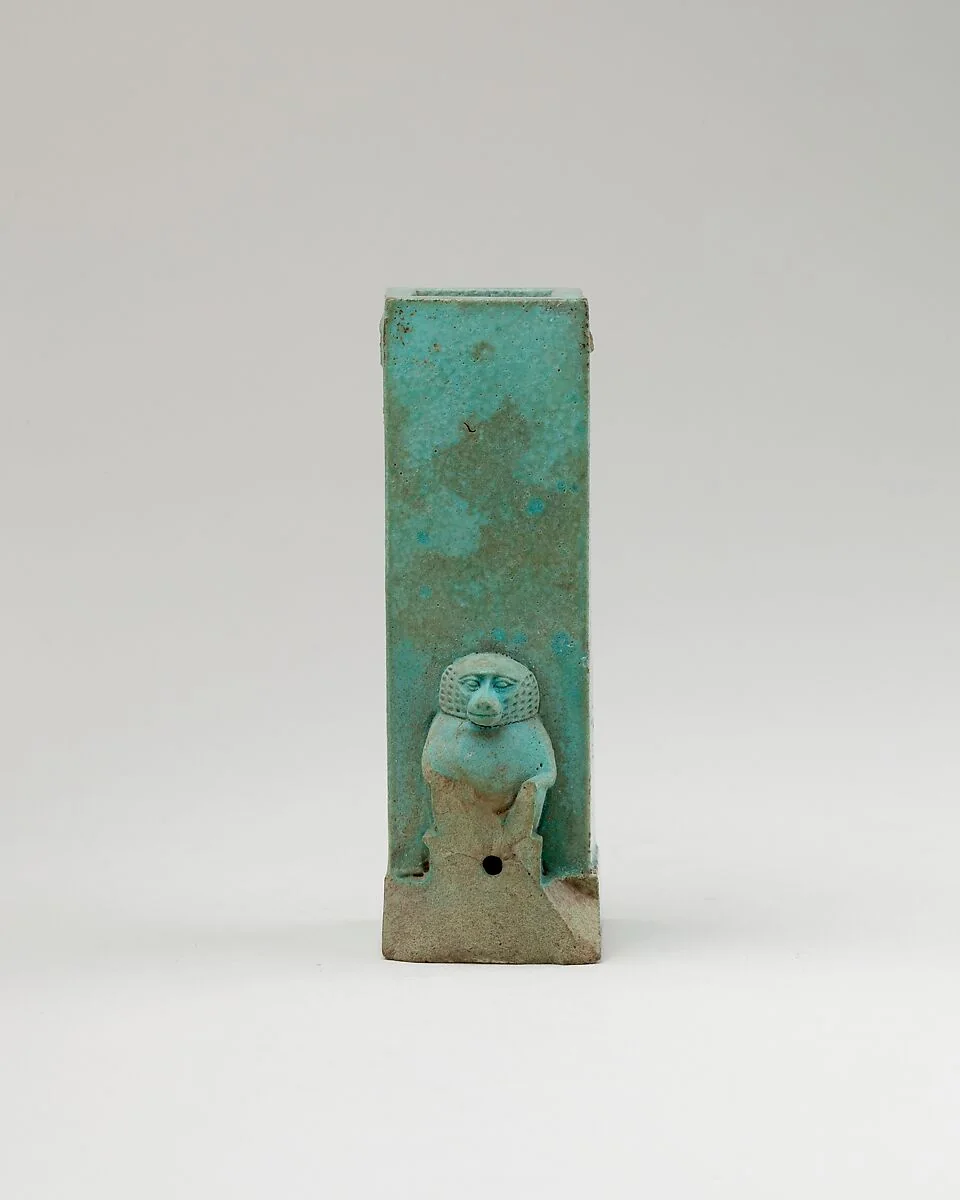
The museum identifies a probable model and offering that refers to water based timekeeping. It does not claim that this small object was a calibrated everyday clock.
This small Egyptian object pairs a water chamber with a seated baboon. It can suggest a miniature timer or dispenser, but the museum's wording is more precise. The Metropolitan Museum of Art considers it a model of a water clock and says it was likely a temple offering. Both qualifications belong in the story.
The object behind the comparison
Met accession 86.1.93 is made of faience and dates to the fourth century BCE, approximately 2300 to 2400 years ago. It measures 8.8 cm high, 2.9 cm wide and 4 cm deep. The catalog records Egypt as its origin but does not provide a specific excavation site. Its acquisition in 1886 is a museum history date, not a documented discovery date.
The entry explains that water inside could drain through an opening between the baboon's legs over a measured interval. It links the likely offering to Thoth's association with knowledge and measurement. That is the museum's interpretation of this particular piece, not a claim that a modern timing test has verified its accuracy.
The larger technology is documented
Janice Kamrin's February 1, 2017 essay places water clocks within a broader Egyptian effort to track time. She describes twelve hours of daylight and twelve of night, and evidence for sundials, shadow clocks and water clocks beginning in the New Kingdom. This context matters: the small model refers to an actual class of ancient timekeeping instruments.
A model does not establish every operating detail
The distinction between a representation and an instrument changes what can be inferred. A calibrated clock would require a known relationship between water level, discharge and elapsed time. The catalog does not supply an operating record, a calibration table or a measured error for this object. We therefore do not assign it a precise timing interval.
A modern timer shown beside it illustrates a shared idea of tracking an interval. It does not demonstrate identical mechanisms or performance. The archaeological interpretation joins practical knowledge with religious use: an offering can refer to a technology without being its everyday working version.
The source record supports human timekeeping and a qualified interpretation of a small ancient model. It provides no evidence of an alien device, and no missing invention story needs to be supplied to make the object interesting.
Read the comparison carefully
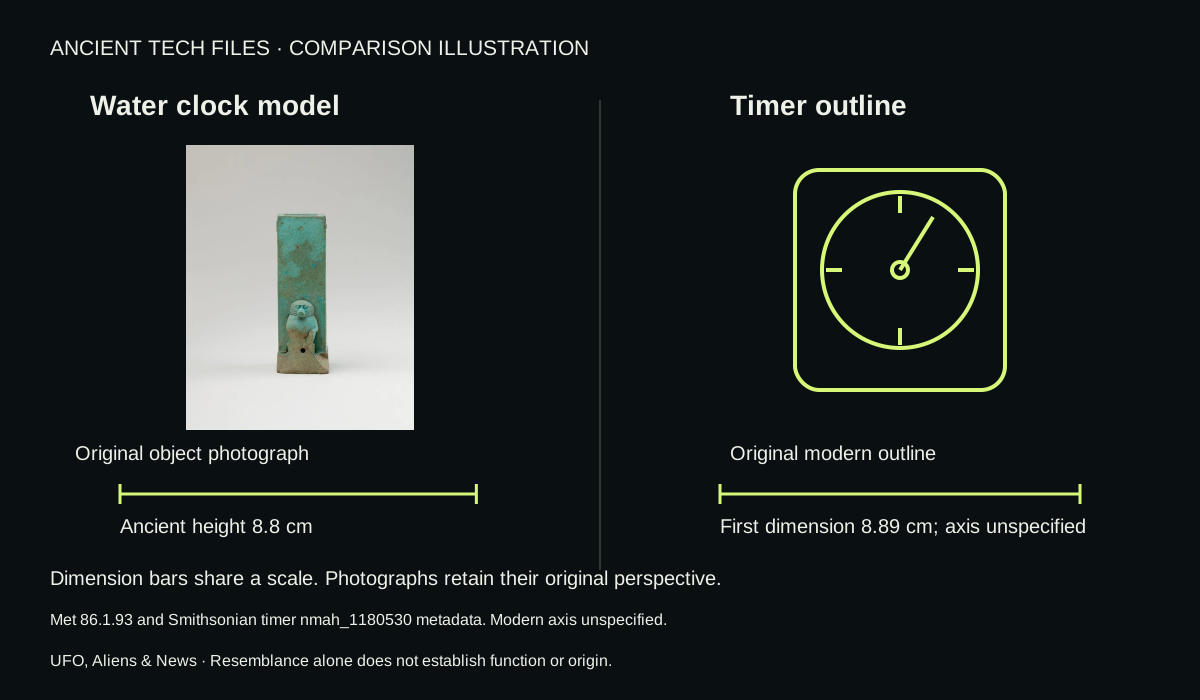
The miniature’s cataloged height of 8.8 cm is compared with a modern timer’s first listed overall dimension of 8.89 cm, whose axis is not explicit in that record. The timer is an original outline based on public catalog metadata, not a reproduction of its restricted photograph. This is a dimensional comparison, not a confirmed match of height or performance.
Explore all seven Ancient Tech Files. A matching published Short has not yet been linked. These source pages can be read independently of a video.
Follow the sources
- The Metropolitan Museum of Art: water clock model 86.1.93 Undated catalog checked November 15, 2026; fourth century BCE, faience, 8.8 cm tall, likely a temple offering. Photograph is public domain.
- Janice Kamrin: Telling Time in Ancient Egypt The Metropolitan Museum of Art, February 1, 2017; broader evidence for Egyptian calendars, hours and timekeeping instruments.
- The Metropolitan Museum of Art: image resources Open Access image policy; object pages used here explicitly mark their photographs Public Domain. Checked November 15, 2026.
- Smithsonian: M. H. Rhodes timer catalog Catalog checked November 15, 2026; first listed overall dimension 8.89 cm, with no explicit axis. The restricted photograph is not used.
Each source note identifies the context and evidence it supports. Linked material establishes only the claims described in its source note. Official attribution and publication do not eliminate uncertainty. Read our editorial standard.
This is original, AI assisted research and analysis compiled from the linked sources. It has not received independent expert review. We distinguish source findings from our interpretation and record substantive corrections. Corrections policy