AARO analysts
The published institutional assessment addresses performance using geometric and wind assumptions. No named pilot interview is used here. [1]
Fast across the screen does not necessarily mean fast through the air.
Our recap introduces the case; this recap is not an independent source. The original records and their limits follow below.
Read the methodology and its assumptions before treating apparent motion as a measured speed.
| Claim | Source | What it establishes | What it does not |
|---|---|---|---|
| The object races just above the sea | [1] | AARO assesses a target well above the surface and strong parallax. | That apparent background motion equals object speed. |
| AARO identified a particular object | [1] | Its assessment constrains performance. | A definitive identity such as balloon, bird or drone. |
| A genuine Navy clip proves alien technology | [2] [3] | Official footage provenance. | An extraterrestrial origin. |
The published institutional assessment addresses performance using geometric and wind assumptions. No named pilot interview is used here. [1]
Statements are paraphrased unless marked as a quotation. No podcast audio or video is reproduced in this section.
Choose the reading that best fits the available evidence.
Your choice is saved only in this browser. It is not sent to us or counted as a YouTube vote.
No public vote totals are collected or shown.
Discuss this file on YouTube ↗A separate pinned poll has not been verified for this file.
AARO found no anomalous performance. Parallax explains the striking apparent motion; the object’s precise identity remains unconfirmed in that assessment.
The ocean appears to race behind a small target. The first impression is speed. The scientific question is how much of that impression comes from the target and how much comes from the aircraft carrying the camera.
Motion parallax is familiar from a moving car: a nearby roadside object sweeps across the view while a distant hill appears to move slowly. Estimating an airborne object’s behavior also requires the camera’s position and motion, its viewing angle, distance to the target, and the background used as a reference.
AARO’s February 2025 analysis assessed the GoFast target as roughly 13,000 feet above the ocean. The office found that parallax accounted for the striking apparent speed and expressed high confidence that the footage showed no anomalous performance.
The assessment did not definitively establish what the object was. Calling it a confirmed balloon, bird or drone would overstate that result. Likewise, an uncertain identity does not erase the value of estimating motion. Investigators can constrain one property while another remains unknown.
AARO’s methodology evaluates different wind and heading scenarios. A speed range produced under those assumptions should not be reduced to a single uniquely measured speed. The assumptions are part of the result.
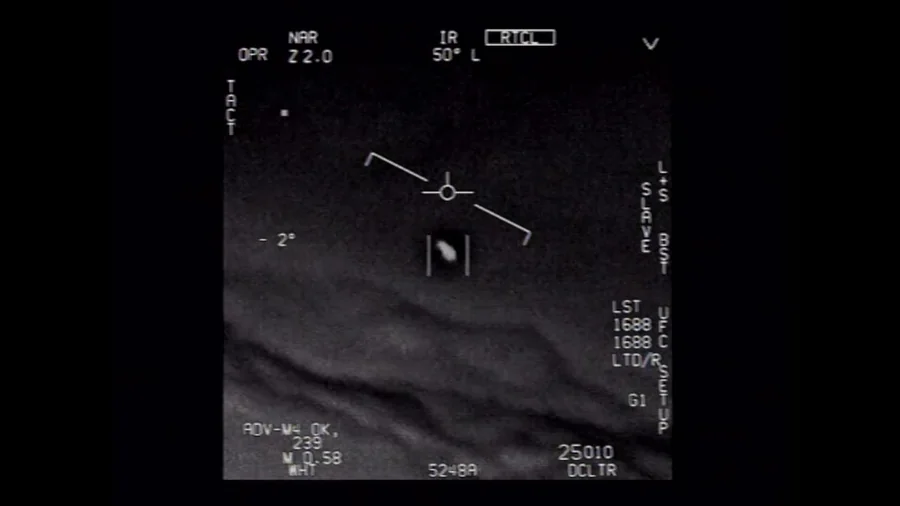
On April 27, 2020, the Department of Defense authorized the release of three unclassified Navy videos, one recorded in November 2004 and two in January 2015. The release addressed uncertainty about the footage’s authenticity. It did not certify an extraterrestrial explanation.
GoFast is one case. Its analysis should not be silently applied to GIMBAL, FLIR, or every account associated with those recordings. Each claim needs its own data and its own assessment. The official GoFast player below allows readers to compare the familiar clip with the linked methodology.
Links document the stated claim or analysis. Inclusion in an official archive does not establish extraterrestrial origin.
 Preprint analysis
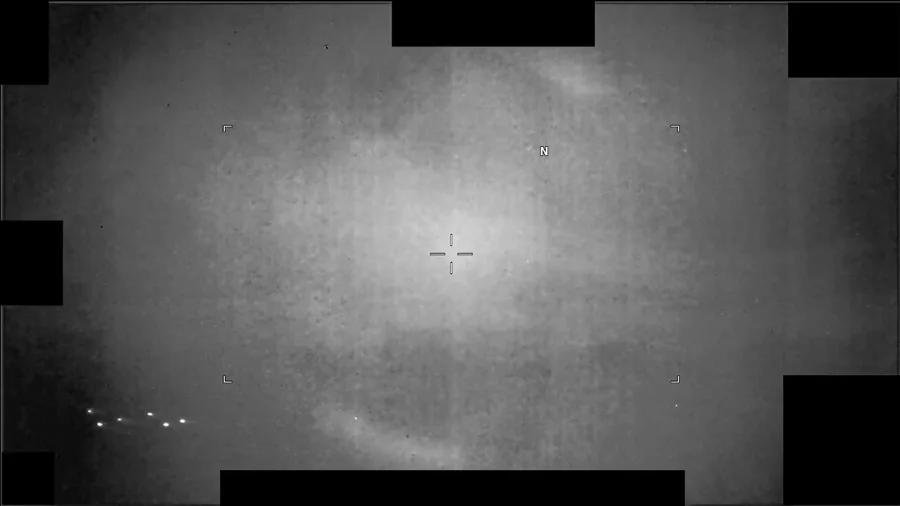
An official infrared video remains labeled unresolved. A reproducible preprint finds independent 7.1 to 7.9 Hz flicker in all six objects and argues that parallax inflated their reported speed.
 Evidence guide
The 34 second Navy recording is authentic government footage. Authenticity establishes provenance, not the object’s distance, speed, identity or origin.
 Scientific framework
Calibrated sensors, useful metadata, and independent observations give an unexplained encounter a path toward investigation.
 Evidence guide
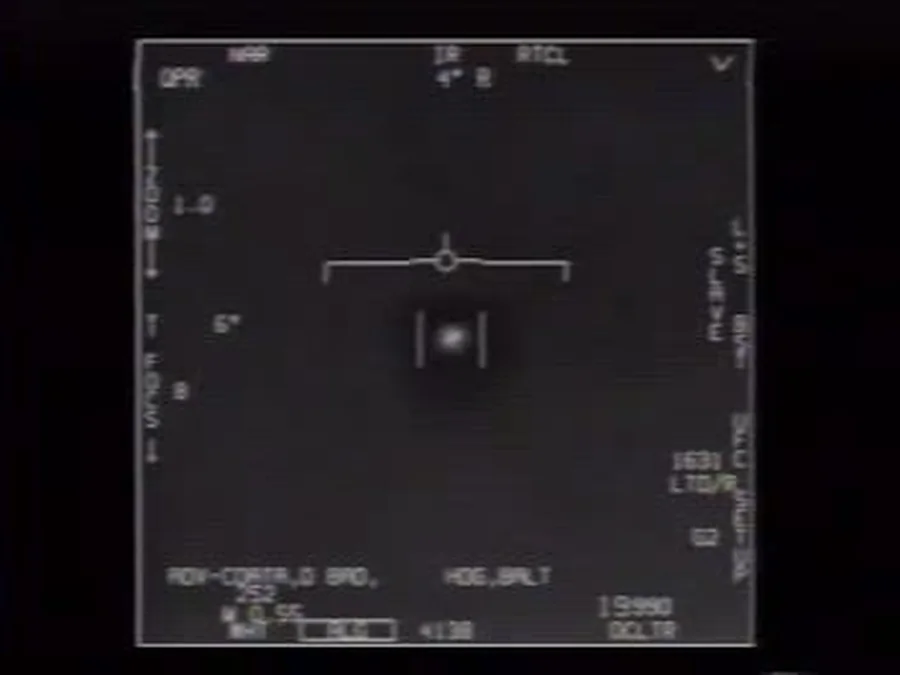
Read the 2004 encounter through separate records: David Fravor’s testimony, Chad Underwood’s later recording and the Pentagon’s release notice.