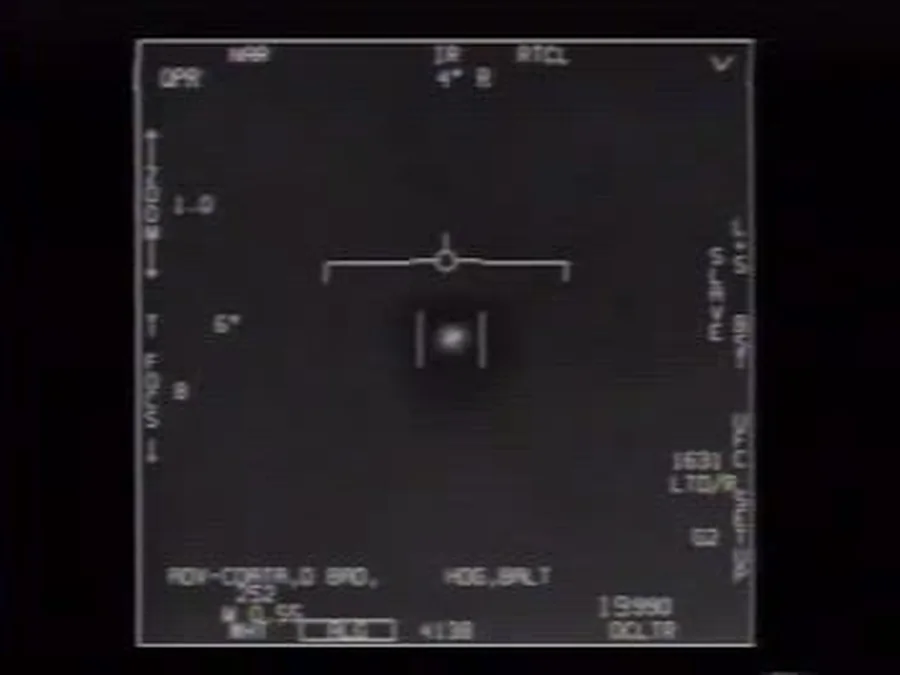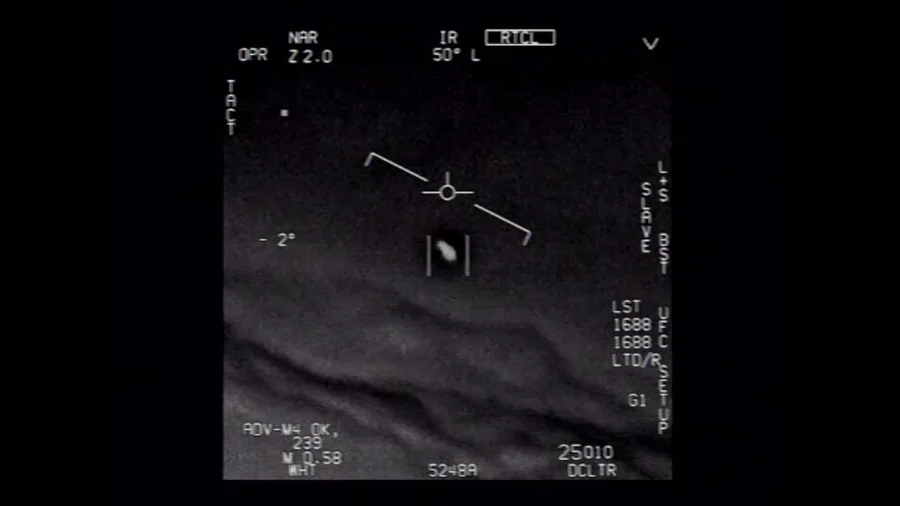
The official file documents six reported objects and an estimated 480 mph value. A non-peer-reviewed preprint presents quantitative evidence favoring birds, but redacted aircraft altitude and telemetry prevent a definitive public reconstruction.
DOW-UAP-PR135 now has two distinct public readings. The government record preserves an aircrew report of six apparently agile objects and labels the video unresolved. A later scientific preprint analyzes the released pixels and argues that the points flicker like independently flapping birds while parallax can reproduce the reported speed.
This is coverage of an October 6 preprint and a September government release, not a new sighting on October 13. The official label and the researchers’ interpretation should not be merged: one describes the government record’s status, while the other proposes a testable explanation.
What do the official video and report establish?
The DVIDS entry says U.S. Central Command submitted one minute of infrared footage to AARO. It lists a generic January 1, 2025 “date taken” field, but the companion mission report gives the actual contact time as July 29, 2025 at 20:22:32 UTC. The archive posted the video on September 18, 2026.
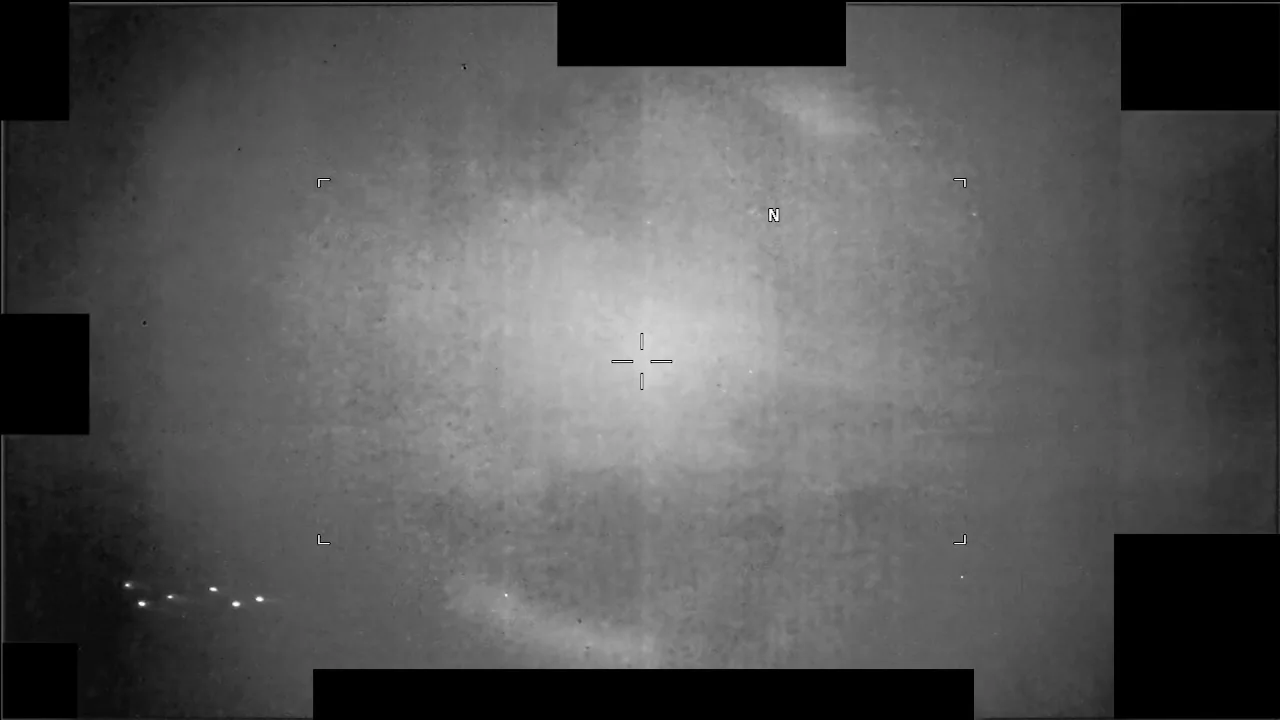
We downloaded the 59.99-second, 1280×720 official file from the DVIDS delivery network. A full-timeline frame review matches the archive description: an island or offshore structure appears first; several bright points enter from the top between about 5 and 10 seconds; the sensor follows them through about 47 seconds; the closing seconds contain magnification changes and no comparable tracked group. Frames around 44 seconds show six separated bright points. This review did not identify their physical nature.
The eight-page DOW-UAP-D108 mission report marks altitude, velocity and trajectory as estimated. It records flight level 220, southeast motion and “48OMPH”—with the letter O—while the official video description interprets the value as 480 mph. The report also records no sensor interrogation or engagement, no advanced capabilities or materials, no effects on people or equipment and no recovered material.
What did the preprint measure?
Haqq-Misra and five coauthors tracked all six points in every frame from 41.3 to 46.3 seconds. They report brightness peaks between 7.11 and 7.85 hertz, with each point oscillating at its own rate and phase. Their controls used planted constant-brightness dots, fixed sensor defects and alternate measurement apertures to test whether compression, pixel sampling or the instrument could create the pattern.
The authors then applied the same measurement to five flying animals recorded by Galileo Project infrared cameras near Las Vegas. Those comparison targets produced 3.4–10.0 Hz brightness beats, overlapping established bird wingbeat ranges. The paper says the six PR135 objects are therefore best explained as a flock of birds.
The association is an analysis, not direct species identification. The paper notes that one brightness pulse may occur once or twice per wingbeat, so the physical wingbeat could be about 7.1–7.9 Hz or 3.6–4.0 Hz. It also says bats and rotating or tumbling objects can flicker, although six independent steady rates make a flock the simpler explanation in the authors’ model.
How can a slow object appear to move at 480 mph?
An airborne camera moving past a nearer object sees that object shift against the distant sea. If the target range is unknown, a speed calculated at the point where the line of sight meets the ground describes the moving ground intersection—not necessarily the object.
Using the report’s 120-knot indicated airspeed, the preprint finds that a stationary object at roughly 66–77% of the aircraft’s height could produce a ground-projected reading of 480 mph. Allowing a slow object moving at plus or minus 20 meters per second widens that band to about 60–84%. This is a conditional model because the aircraft altitude is redacted.
The logic resembles the range problem in AARO’s GoFast analysis: angular motion alone does not provide a unique physical speed. It does not prove that every point in PR135 was slow. It shows that the reported value does not require a 480 mph object.
Where is the bird explanation strongest—and weakest?
The strongest evidence is the repeated, out-of-phase brightness modulation across six separately tracked points, plus controls aimed at the video’s 7.49 Hz compression cadence. Unlike a shape impression, a measured frequency can be reproduced from the released file. The authors also published code, output tables, comparison clips and checksums in a Zenodo package.
The largest public uncertainty is altitude. The preprint says that if the aircraft was above the reported flight level 220, a slow object producing the apparent speed would have been at roughly 4.8 kilometers or higher—above typical nocturnal migration, though within reach of some high-flying birds. The proposed location near Kuwait’s Qaruh Island and the inferred MQ-9 aircraft type are explicitly presented as unconfirmed inferences.
The paper also acknowledges that the imagery cannot exclude a fast distant object. Its bird conclusion rests mainly on the flicker interpretation, while the parallax model removes the need for extraordinary speed. Releasing aircraft altitude, range, track, ground speed and original telemetry would provide stronger tests.
Is the case resolved?
Not officially in the sources reviewed here. DVIDS still titles the record “Unresolved UAP Report.” The October paper is a v2 preprint submitted to Scientific Reports; peer review or acceptance was not verified. One author lists NASA Goddard as an affiliation, but that does not make the manuscript a NASA or AARO determination.
The paper’s authors disclose that all are unpaid members of the UAP Science Advisory Council, that Galileo Project researchers supplied comparison footage and that the analysis code, figures and drafts were developed with Anthropic’s Claude Opus. They report no financial competing interests. Those disclosures help readers evaluate the work; they do not validate or invalidate its measurements.
We inspected the paper, official video timeline, mission report and reproduction-package inventory, but did not independently rerun the code or verify every numerical result. A fair current summary is narrower than either “confirmed alien craft” or “officially debunked”: an unresolved government video now has a detailed, reproducible bird hypothesis whose critical altitude inputs remain redacted.
For the wider provenance trail, use our government UFO files guide. For why missing range and metadata matter, see the unresolved-report explainer.
Watch the original source
Follow the sources
- All-domain Anomaly Resolution Office / DVIDS: DOW-UAP-PR135 Official 59.99-second infrared video, DVIDS ID 1023397 and filename DOD_111985782; posted September 18, 2026. File metadata and the full timeline were sampled visually October 13, with the tracked interval inspected more closely.
- Department of War: DOW-UAP-D108 mission report Eight-page declassified mission report. The official host rejected the standard download client during this review; an unmodified copy in the authors’ Zenodo reproduction package matched that package’s published checksum and was visually reviewed October 13, 2026.
- Haqq-Misra et al.: brightness flicker and bird-wingbeat analysis Preprint submitted October 6 and revised October 7, 2026; submitted to Scientific Reports, but peer review and journal acceptance were not verified. Full 17-page v2 paper reviewed.
- Haqq-Misra et al.: PR135 reproduction package Zenodo record published October 6 and revised October 7, 2026; includes the official video and report copies, analysis code, control outputs, figures, comparison clips and checksums. Availability was inspected; this publication did not independently rerun or validate the numerical analysis.
Each source note identifies the context and evidence it supports. Linked material establishes only the claims described in its source note. Official attribution and publication do not eliminate uncertainty. Read our editorial standard.
This is original, AI-assisted research and analysis compiled from the linked sources. It has not received independent expert review. We distinguish source findings from our interpretation and record substantive corrections. Corrections policy