Mitch Stanley
A telescope observer interviewed in contemporary local reporting who identified aircraft. [3]
The moving lights and the later flare display need separate explanations.
A verified matching Short is not linked yet. The evidence and source documents are available below.
No original sighting footage with cleared reproduction rights is embedded here.
The letters address agency responses and records availability. They do not reconstruct every light reported that evening.
| Claim | Source | What it establishes | What it does not |
|---|---|---|---|
| All observers saw one large craft | [1] [3] | People reported unusual lights; one telescope observer described aircraft. | That every report describes one physical object. |
| Military flares explain the later array | [4] [7] | Named testimony and a published analysis support this explanation. | An identification of every earlier moving light. |
| Destroyed logs prove extraordinary activity | [6] | The agency said operating records were not retained beyond six months. | The contents of those absent records or an extraterrestrial cause. |
Observers report moving lights and a later array over Arizona. [1] [2]
Original local reporting includes the telescope observer Mitch Stanley. [3]
A published interview with Drew Sullins describes flare operations. [4]
Bruce Maccabee publishes analysis of the later lights and excludes the earlier sightings from that conclusion. [7]
A telescope observer interviewed in contemporary local reporting who identified aircraft. [3]
Maryland Air National Guard spokesman quoted about flare operations in a dated interview transcript. [4]
His later CNN interview recounts his own perception. His former office does not make that account a technical finding. [8]
Statements are paraphrased unless marked as a quotation. No podcast audio or video is reproduced in this section.
Choose the reading that best fits the available evidence.
Your choice is saved only in this browser. It is not sent to us or counted as a YouTube vote.
No public vote totals are collected or shown.
Visit our YouTube channel ↗A separate pinned poll has not been verified for this file.
Military flare training provides a documented conventional explanation for the later lights. Applying that explanation to every earlier report is a separate claim. The records reviewed here do not establish extraterrestrial origin.
The Phoenix Lights were reports of unusual lights over Arizona on March 13, 1997. The essential distinction is between an earlier moving formation, reported around 8 p.m., and the later lights commonly associated with military flares around 10 p.m. A photograph or explanation belonging to one sequence cannot automatically identify the other. Neither an unresolved account nor a witness’s certainty establishes an alien spacecraft.
NUFORC’s preliminary summary describes calls about a moving cluster from several Arizona communities. It also warns that its account preceded written witness reports and could change. Its displayed August 1997 date should not be mistaken for the date of every call or sighting.
A particularly useful Ahwatukee submission separates those dates: an observation entered as 8:15 p.m. on March 13, a report on March 18, and website posting in March 1998. The unnamed observer described five lights moving overhead, obtained binoculars and thought stars might be visible between the lights. The report also says the observers could not determine altitude. It preserves a near-contemporary account without supplying an independently measured size or distance.
Bruce Maccabee’s 1999 video-analysis article explicitly distinguishes those early reports from the lights recorded roughly two hours afterward. It is a useful safeguard against combining different observations under one famous name.
For the later sequence, Maryland Air National Guard spokesman Capt. Drew Sullins described actual flare training in an August 1997 interview. His account concerned a visiting unit training from Davis-Monthan, not an identification of everything reported across Arizona.
Tony Ortega’s June 1997 reporting includes an important disagreement: two newspaper writers described similar lights, but differed about whether something connected them. Ortega also interviewed amateur astronomer Mitch Stanley, who said his telescope resolved individual aircraft and lights associated with their wings. That is an observation offered in support of a formation of planes, rather than a generic assertion that witnesses imagined the event.
It remains testimony reported by a journalist. It does not supply aircraft registration numbers or a flight track matching every location and time. Conversely, an observer’s impression of a dark connecting surface is not a measured outline. A case assessment should keep both accounts visible without turning either into a definitive identification of all the night’s reports.
In the published interview, Sullins said his operations staff confirmed that the 104th Fighter Squadron was flying and dropping flares that night. He attributed the delayed public explanation to an initial failure to check visiting-unit logs. These are an identified spokesman’s statements about information obtained from others; he said he was not flying. He also declined to attribute every triangular-object report to flares.
Luke’s May 1997 letter says its aircraft were on normal training missions and had no involvement with the reported lights. It acknowledges calls to the base, while saying its public-affairs staff had not given aerial flares as the explanation. That answers a question about Luke’s aircraft and statements. It does not establish that a visiting unit operating from a different base released no flares.
The later Davis-Monthan response is narrower still: the requested operating documents were no longer held, because the cited retention period was six months. Missing records limit retrospective checking. Their destruction under a stated retention policy is not evidence, by itself, of a cover-up or of an extraterrestrial encounter.
Yes. Maccabee reported triangulating the later lights from different recording locations and placing the analyzed March array southwest of Phoenix over the Air Force range. His paper also described downward motion too small to be obvious at that distance. He concluded that high-altitude flares reasonably explained the analyzed array, while explicitly excluding the 8 to 9 p.m. sightings from that conclusion.
This is a published investigator’s analysis, not a calculation independently reproduced for this dossier. The article also examines January 1998 lights; its detailed January map must not be presented as the March 1997 event.
| Record | Useful evidence | Limit |
|---|---|---|
| NUFORC submissions | What observers reported and when reports were filed. | Unverified descriptions; approximate timing and distance. |
| Stanley interview | A telescope observer’s aircraft identification. | No preserved telescope image or matched flight record in this review. |
| Sullins interview | A named military spokesman’s flare-operation account. | Transcript republication, not the underlying operating logs. |
| Air Force letters | Documented agency responses and record availability. | Neither is a complete reconstruction of the evening. |
| Maccabee analysis | Published triangulation supporting later flares. | Specific analyzed lights; it excludes the early sightings. |
| Symington transcript | His own later description of what he believed he saw. | A retrospective account, not sensor corroboration. |
Yes. In CNN’s August 2011 transcript, Symington describes seeing a large craft cross the valley while he stood with other people near State Route 51. He places his experience earlier than the later flare activity. That is firsthand testimony about his own perception, given years afterward. His former office does not transform the recollection into a government determination, nor provide the missing measurements needed to establish the object’s dimensions or origin.
The main unresolved task is matching individual early reports to independently timed tracks, images and observing locations. A list of similar descriptions alone cannot prove that every person saw the same object. A late video needs its own recording time, location and provenance before it can support an argument about an earlier observation.
Those limits do not make all explanations equally strong. The flare account has a named military source; the aircraft-formation explanation has a specific telescopic witness. An extraterrestrial explanation would need affirmative evidence of that origin, not simply questions left unanswered by either conventional account.
Review scope: this dossier examines the linked written records and transcripts. We did not independently analyze original videotapes, listen to the 1997 interview recording, obtain raw radar returns or reproduce a trajectory calculation. The two military letters are archive copies of agency correspondence, not newly released 2026 findings. Related reading: UFO, UAP and USO definitions and the Nimitz case and its separate evidence record.
Explore the UFO Files case library ↗ · Choose another evidence question ↗
Links document the stated claim or analysis. Inclusion in an official archive does not establish extraterrestrial origin.
 Case dossier
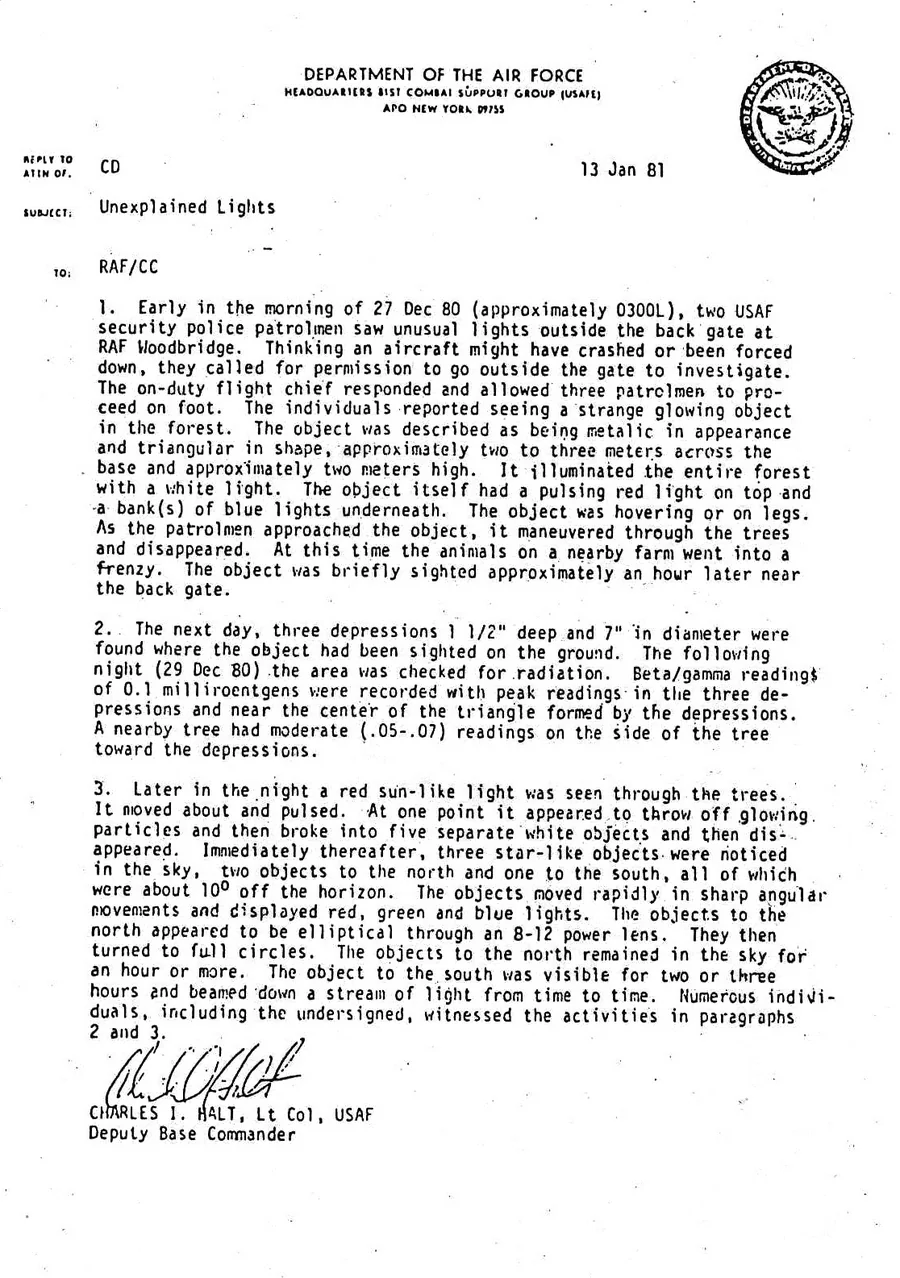
A document-first guide to the December 1980 reports, the Halt memo’s date discrepancy, the lighthouse explanation and the limits of the radiation evidence.
 Case dossier
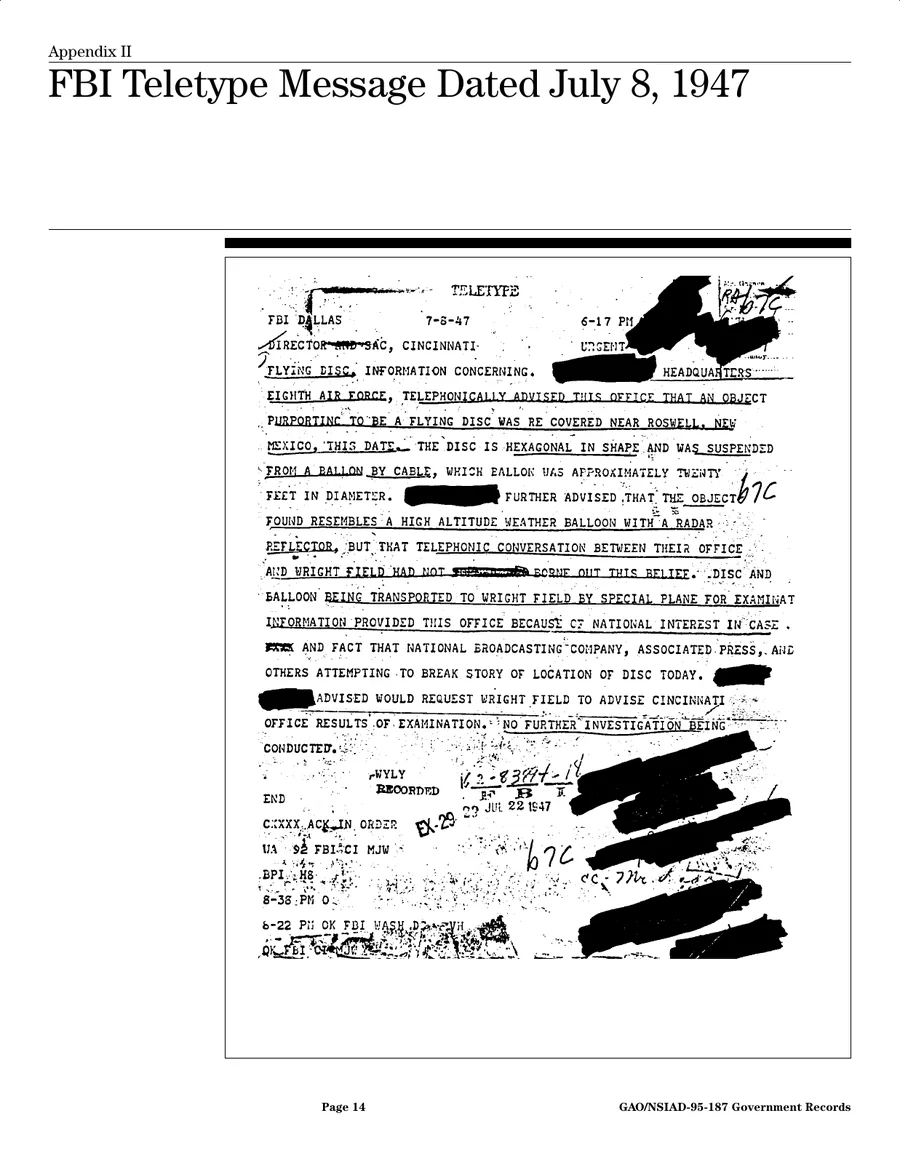
The military recovered debris near Roswell in 1947. The surviving records, Project Mogul explanation and later body claims answer different questions, and need different tests.
 History & reported accounts
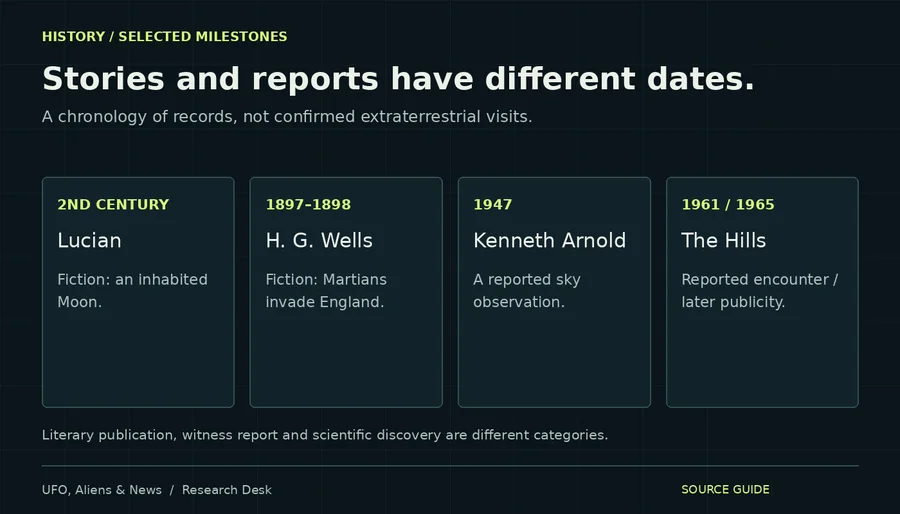
There is no confirmed first alien visit. Follow the separate histories of imagined worlds, reported UFOs and encounter claims through dated sources.
 Report explainer
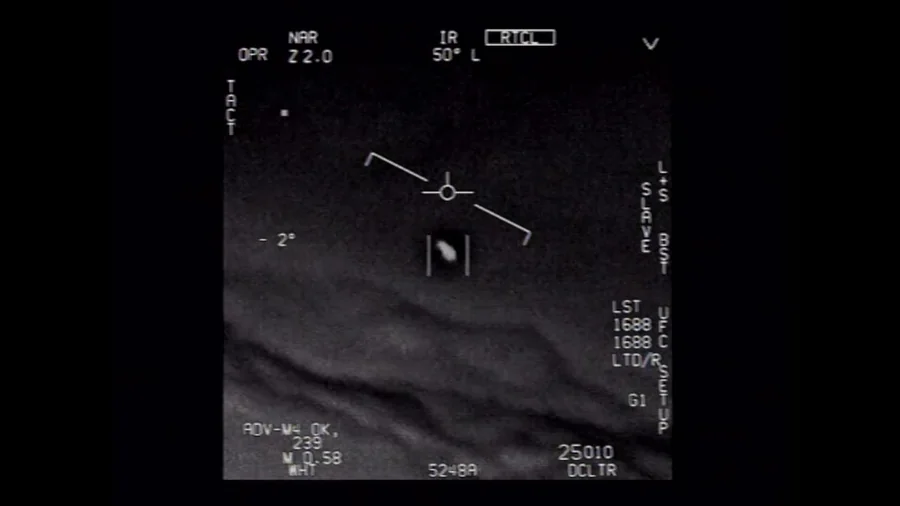
The FY2024 report helps explain retrospective submissions, changing case status and the limits of missing sensor data.