Charles I. Halt
Memo author. The first paragraph reports what patrolmen told him; the later observations have a different firsthand scope. [1]
The Halt memo is real. Which parts did its author actually witness?
Our recap introduces the case; this recap is not an independent source. The original records and their limits follow below.
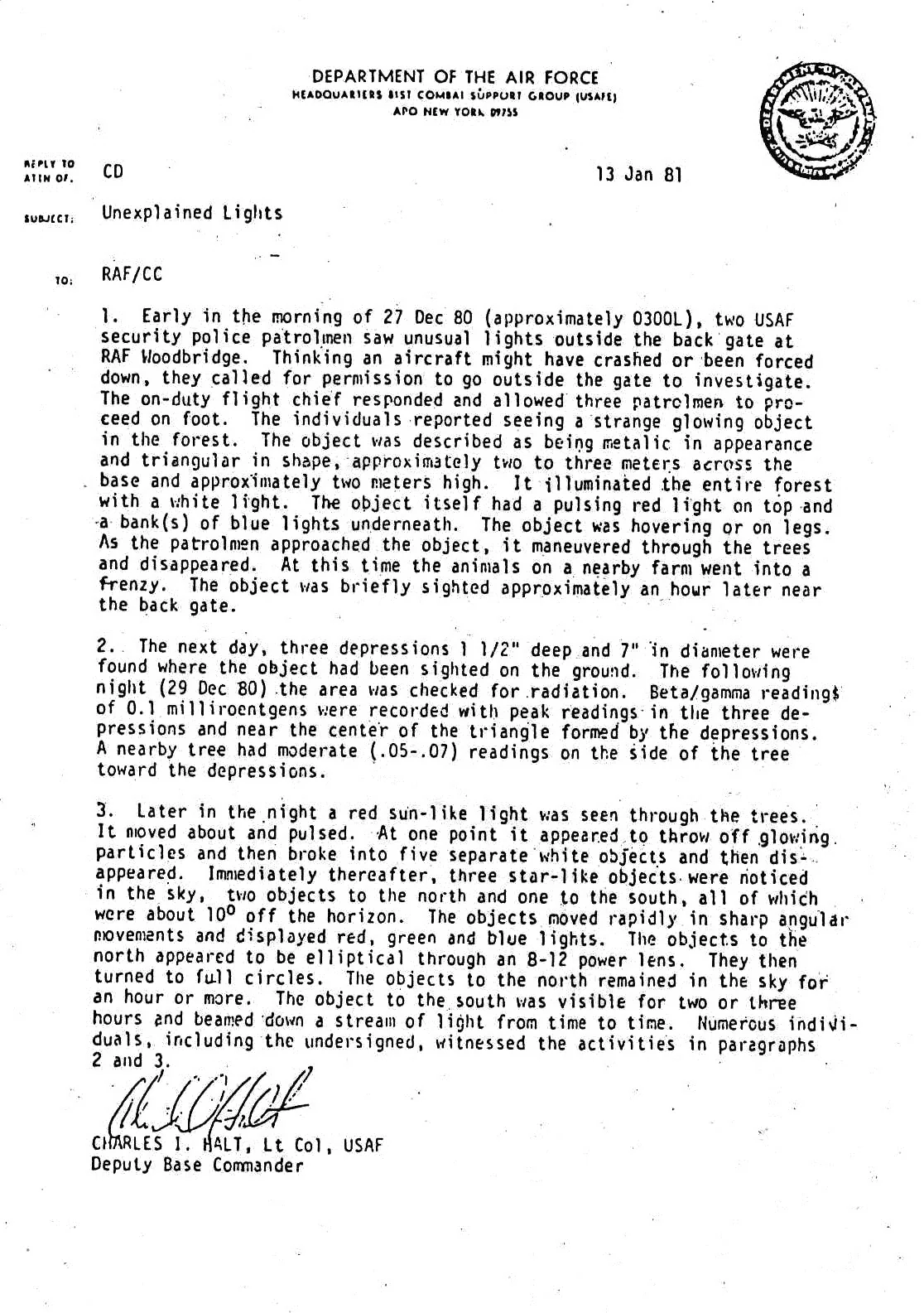
The linked PDF is an archive guide. The displayed memo records observations and secondhand reports, not a confirmed craft identification.
| Claim | Source | What it establishes | What it does not |
|---|---|---|---|
| Halt witnessed a landed triangular craft | [1] | Halt relayed patrolmen’s account in paragraph one. | That he personally witnessed that first reported object. |
| The reported radiation proves a landing | [1] [6] | The memo records numerical readings; Parliament reported no recorded official assessment. | A calibrated anomaly or its cause. |
| The Ministry of Defence solved every observation | [3] | It judged the incident did not warrant action on defence grounds. | A scientific identification of every light. |
The memo dates observations to December 27 and 29; later researchers argue for December 26 and 28. The discrepancy is preserved. [1] [4]
Halt dates his written report. [1]
A parliamentary answer says there is no record of an official assessment of the radiation readings. [6]
The National Archives releases the cited Ministry of Defence file. [2] [3]
Memo author. The first paragraph reports what patrolmen told him; the later observations have a different firsthand scope. [1]
Statements are paraphrased unless marked as a quotation. No podcast audio or video is reproduced in this section.
Choose the reading that best fits the available evidence.
Your choice is saved only in this browser. It is not sent to us or counted as a YouTube vote.
No public vote totals are collected or shown.
Discuss this file on YouTube ↗A separate pinned poll has not been verified for this file.
Military personnel reported unusual observations. The surviving documents establish those reports and the government’s response, but do not establish an extraterrestrial craft.
The Rendlesham Forest incident concerns lights reported near RAF Woodbridge in Suffolk in late December 1980. Its documentary importance is real: a deputy base commander submitted a written account, and British officials retained it. Its meaning requires more care. A military report can establish that observations were reported without establishing the nature, distance or origin of everything described.
This dossier separates the early record from later interpretation. The useful questions are which night a claim concerns, whether its author witnessed it, and whether another record independently tests it.
The January 13, 1981 memorandum, headed Unexplained Lights, has three numbered paragraphs. First, Lieutenant Colonel Charles Halt recounts patrolmen’s report of a glowing, apparently triangular object outside the base. Second, he describes ground depressions and radiation readings. Third, he reports lights seen through trees and farther away in the sky.
Halt explicitly places himself among the witnesses to the second and third paragraphs. The first paragraph is his account of what other men reported. It should not become “Halt saw a landed triangular spacecraft” in a headline. Nor does official stationery settle whether the observers correctly judged an object’s shape, location or movement.
The memo dates the initial observation to December 27 and the later radiation check to December 29. Researcher Ian Ridpath identifies both as one-day errors, giving December 26 and 28. Investigator James Easton’s reconstruction likewise places the first patrol early on December 26 and Halt’s expedition on the night of December 27 to 28. We retain the disagreement rather than silently changing the document.
The National Archives research guide identifies a 2001 release under the predecessor to Britain’s Freedom of Information Act, followed by the opening of file DEFE 24/1948/1 in August 2009. That file includes the memo alongside later briefings and correspondence. Hundreds of pages about a case should not be counted as hundreds of independent observations.
The lighthouse is a specific conventional explanation for a recurring distant light. It is not an official identification of every reported event. In his 2006 account of his investigation, James Easton describes Ian Ridpath’s lighthouse explanation and Halt’s rejection of it. Easton also reproduces John Burroughs’s statement describing the patrol following a beacon until they recognized a lighthouse.
That passage matters because it concerns what a participant reportedly recognized during the search. It does not make every light in every account the same light. Assessing the explanation requires matching a particular observation to direction, time and viewing position. Conversely, a witness’s rejection is not itself a geometric demonstration that the lighthouse was impossible. We have not independently reconstructed the 1980 sightlines.
The memo reports a peak numerical reading of 0.1 milliroentgens, with smaller readings at a nearby tree. It does not supply a complete measurement procedure, calibration record or background comparison. These omissions prevent this page from treating the numbers as a demonstrated anomaly, let alone as a signature of a particular craft.
There is a particularly useful official limit. In an October 14, 1997 parliamentary answer, Lord Gilbert said there was no record of an official assessment of Halt’s radiation readings. That is an absence of recorded assessment, not a government finding that the readings were extraordinary. It also does not establish that every later private assessment is correct. The ground marks need the same discipline: calling depressions “landing marks” adds a cause that their existence alone cannot establish.
The government’s stated conclusion concerned defence significance. The National Archives’ August 2009 release commentary says MoD had not explained the incident, but judged it did not warrant action on defence grounds. That limited institutional judgment should not be expanded into either proof of extraterrestrials or a completed scientific explanation of every sighting.
In October 2001, Lord Bach said the MoD’s USAF material consisted of Halt’s memorandum, that the papers showed no follow-up questions to Halt, and that records from the period documented no unusual radar returns. Those are statements about what the department held, not a claim that officials had examined every possible record.
A separate January 2001 answer said the requested 1980 radar records no longer existed, describing three-year paper retention and thirty-day reuse of recordings. An absent historical recording cannot now be independently reanalysed. That limitation should accompany confident claims about what radar did or did not prove.
Later interviews may add testimony, but their publication date and distance from the event matter. A detail first appearing decades afterward should not be inserted into the 1981 memo as though it had always been there. Equally, an older document’s silence is not automatically proof that an event was impossible; it identifies a question for corroboration.
The Archives guide records that Halt made an audio tape during his expedition. This review inspected the memo scan, archival guidance and parliamentary answers, but did not listen to the complete recording or inspect the original witness-statement scans. It therefore makes no independent claim about exact flash intervals, voices or tape completeness. A recording of observers describing lights can preserve their reactions without, by itself, measuring a light’s distance or identifying its source.
Rendlesham remains useful to study because these differences are visible in the record. A stronger assessment would connect each specific claim to inspectable observations and their limitations. More retellings alone do not supply that connection. For the wider archive, use our government UFO files guide; for terminology, see UFO, UAP and USO explained.
Explore the UFO Files case library ↗ · Choose another evidence question ↗
Links document the stated claim or analysis. Inclusion in an official archive does not establish extraterrestrial origin.
 Case file
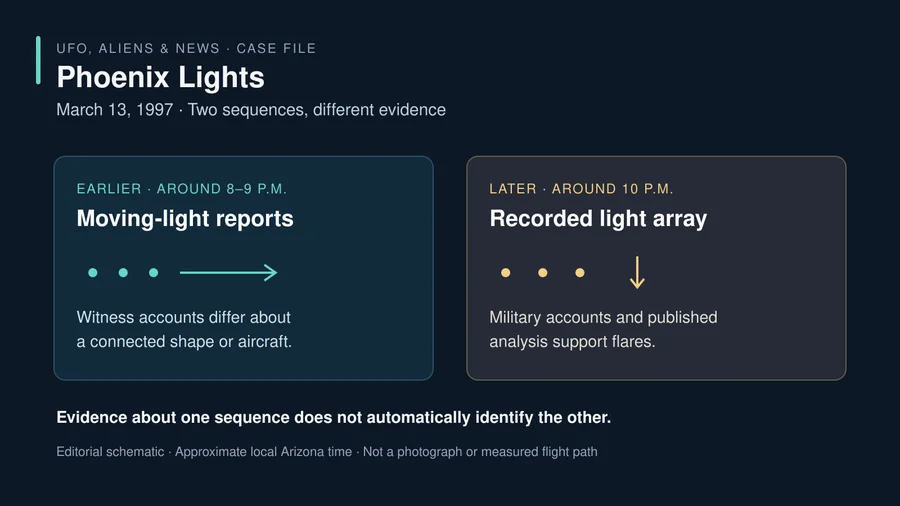
Early moving-light reports and the later flare footage are different parts of the Phoenix Lights story. Original reports and Air Force records show why that distinction matters.
 Case dossier
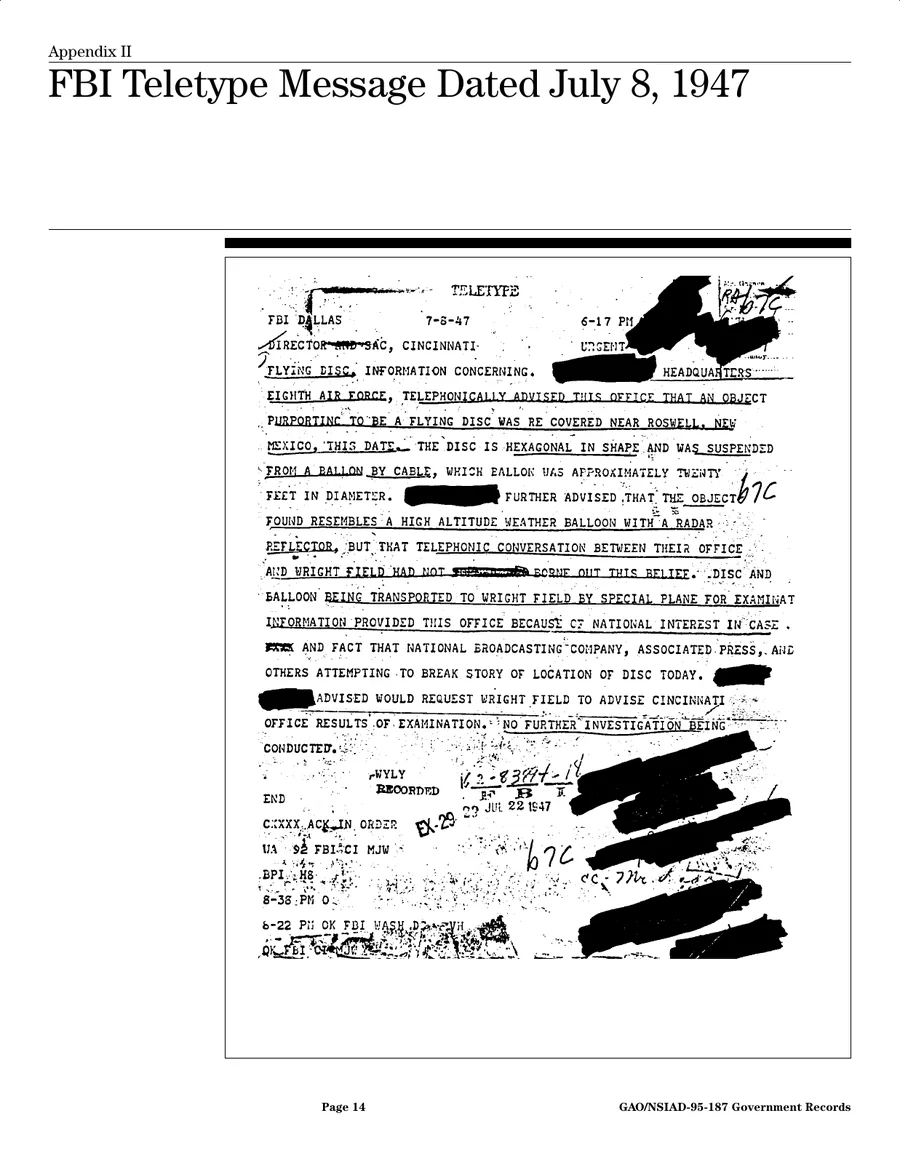
The military recovered debris near Roswell in 1947. The surviving records, Project Mogul explanation and later body claims answer different questions, and need different tests.
 History & reported accounts
There is no confirmed first alien visit. Follow the separate histories of imagined worlds, reported UFOs and encounter claims through dated sources.
 Report explainer
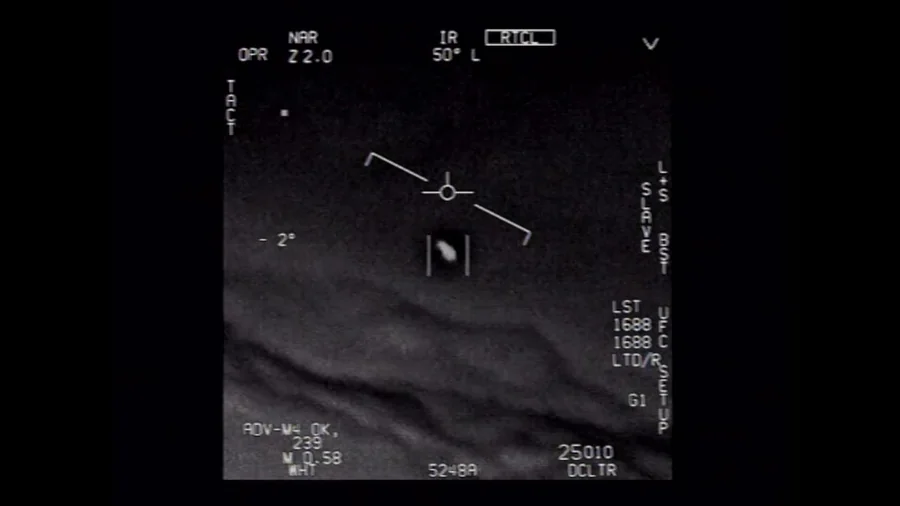
The FY2024 report helps explain retrospective submissions, changing case status and the limits of missing sensor data.
