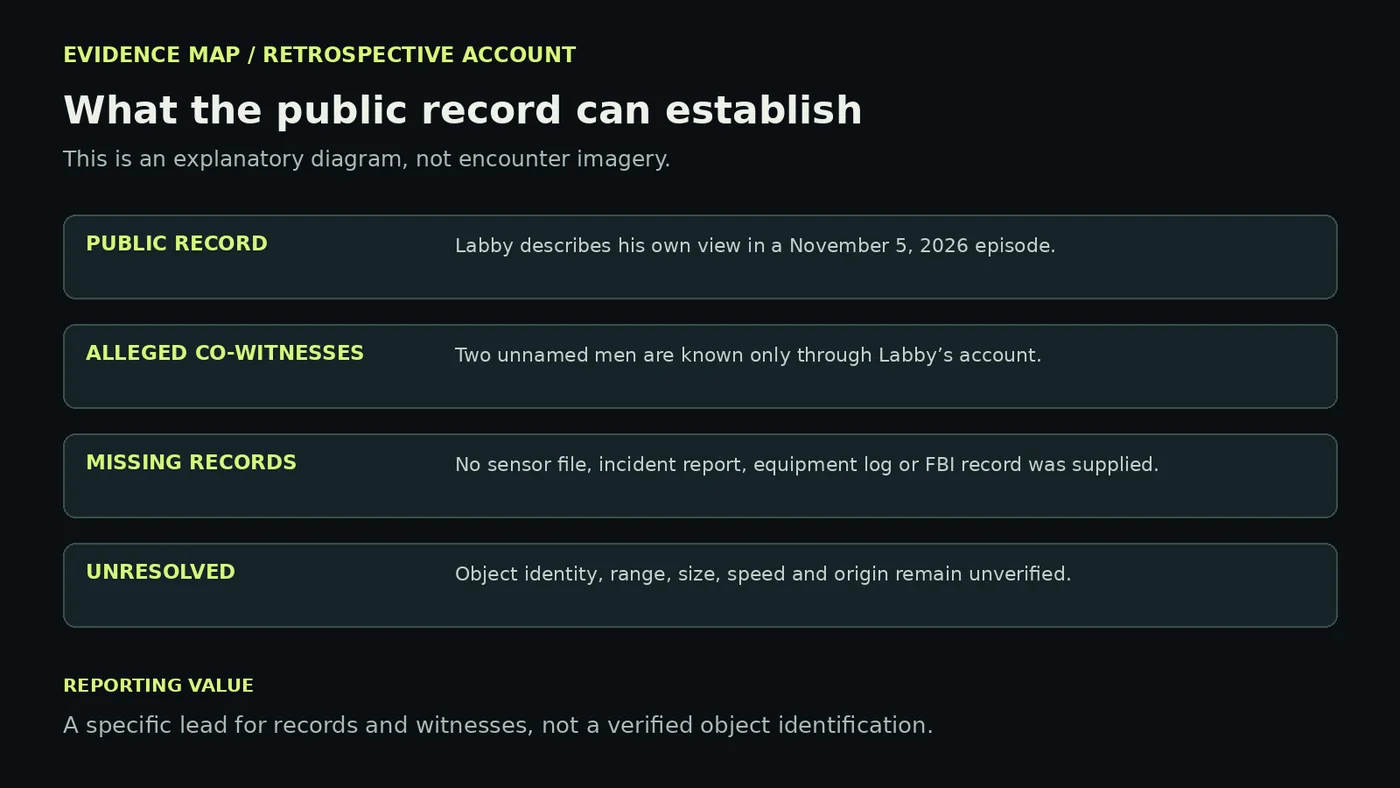
The episode preserves Labby’s firsthand account. It does not independently verify his service history, the two alleged co-witnesses, an FBI response or the object’s identity and performance.
Logan Labby says that while serving in Air Force Security Forces in 2008, he and two colleagues viewed a large V-shaped object through night-vision goggles over Schriever Air Force Base in Colorado. The episode published November 5, 2026, presents his firsthand account, not a contemporaneous military record or an independently corroborated finding. His service history was not independently verified in the reviewed sources.
What does Labby say he saw?
Labby told Ryan Graves on the Safe Aerospace Podcast that the three men were on a night shift when he checked out night-vision equipment and took it to a dark area inside the restricted base. He said he noticed a V-shaped object with several lights, that the goggles were passed among the three men and that he could not see the object when he lowered the equipment.
He estimated that the object was roughly the size of a football field and said it moved without an audible engine or visible propulsion. Those are the witness’s retrospective impressions. The episode supplies no range measurement, altitude, imagery, radar record, equipment log or environmental data that would let an outside analyst test the object’s size, distance, speed or identity.
When does he place the event?
Labby placed the event approximately in spring 2008 but said he could not recall the date or month. The transcript is garbled around the seasonal reference, so it does not support a narrower date. He placed the time at roughly 9 or 10 p.m.
Labby said he did not personally see a sudden acceleration. According to his account, a third man later said the object “took off.” That reported movement is therefore secondhand within the episode.
Are the other witnesses independently on record?
The other two alleged witnesses are not identified in the episode and no statements from them were published with it. Labby said the group did not report the observation that night because they feared ridicule and possible effects on their security clearances. No contemporaneous report is available in the reviewed sources.
The publisher-hosted transcript also contains material errors, including “Logan Levy” for Logan Labby, “Shrewsbury” for Schriever, “David Grosch” for David Grusch and “Commander Frazier” for David Fravor. Publisher title and metadata control Labby and Schriever here; the erroneous transcript forms are not treated as facts.
What would the claimed FBI contact establish?
Labby said he later filed an account with Americans for Safe Aerospace and spoke with the FBI. Even if that interview occurred as he described, it would show only that investigators received his account, not that they verified the sighting, identified an object or reached any finding. No FBI confirmation, finding or case record was published with the podcast.
Americans for Safe Aerospace’s website describes its general witness-reporting process. That description does not independently corroborate Labby, the event or an FBI outcome.
What evidence could move the account forward?
The episode’s most supportable public-interest point is about reporting. Labby describes the decision not to report the observation as a security failure and encourages service members to document unusual activity. His account may help researchers seek equipment logs, duty rosters, contemporaneous records or the other alleged witnesses.
Until such records or independent testimony are available, the evidence supports a narrower conclusion: Labby publicly described an observation he says he shared with two other men. It does not establish what was in the sky, measured extraordinary performance or demonstrate an extraterrestrial cause.
Review scope: the publisher page and transcript, Apple’s episode metadata and Americans for Safe Aerospace’s description of its reporting work. The podcast audio was not independently transcribed, the two alleged co-witnesses were not identified and no service record, sensor file, FBI record or contemporaneous incident report was available in the reviewed sources.
Follow the sources
- Safe Aerospace Podcast: Logan Labby episode and transcript Publisher page and transcript; episode published November 5, 2026. The transcript contains material name and place-name errors, so publisher metadata controls those fields.
- Apple Podcasts: Airman Describes a UAP Three Airmen Saw Through Night Vision Publisher metadata confirms the November 5, 2026 at 5:00 p.m. UTC publication time, 57-minute runtime and episode summary. It does not independently verify the account.
- Americans for Safe Aerospace: witness reporting The organization describes its general witness-reporting work. Its site does not independently corroborate Labby, the event or an FBI outcome.
Each source note identifies the context and evidence it supports. Linked material establishes only the claims described in its source note. Official attribution and publication do not eliminate uncertainty. Read our editorial standard.
This is original, AI-assisted research and analysis compiled from the linked sources. It has not received independent expert review. We distinguish source findings from our interpretation and record substantive corrections. Corrections policy