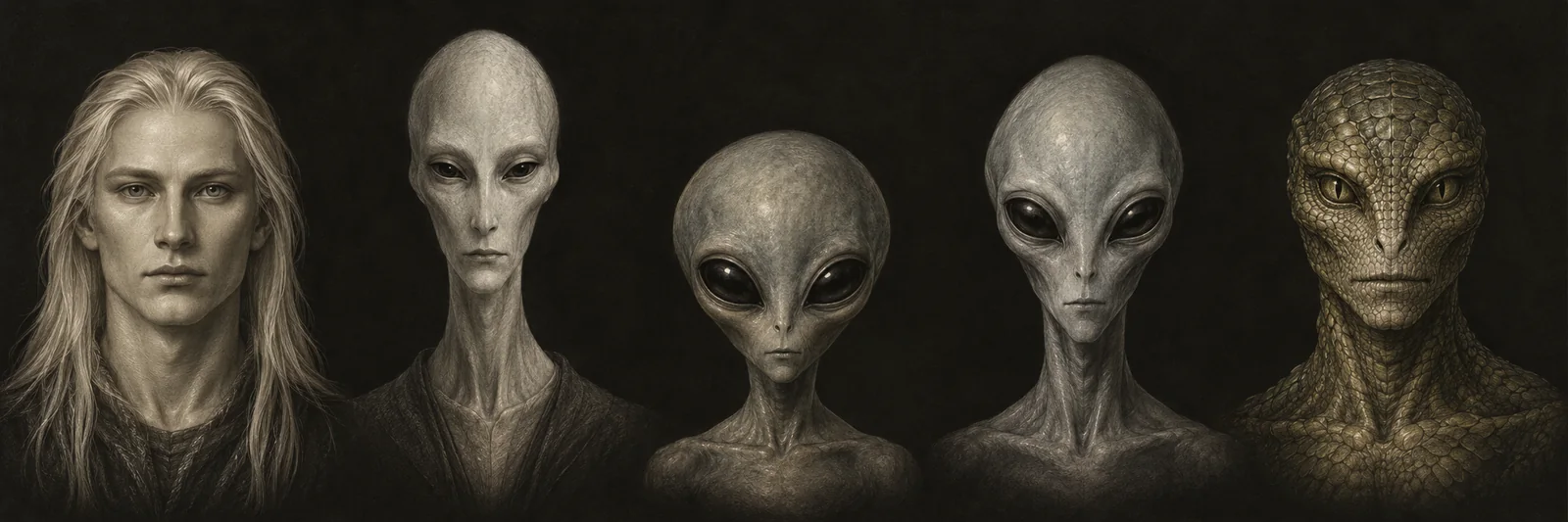
This entry documents a motif and its sources. It does not establish an alien species, home world, anatomy or capability.
Is there a reptilian alien species name?
No scientifically established reptilian alien species is identified by the sources reviewed here. “Reptilian” and “Reptilians” are descriptive labels in UFO lore, not verified biological classifications.
A name assigned by a writer does not establish a species, its home world or a real encounter. For this guide, separate three questions: what a figure is called, which author or account uses that name, and what independent evidence supports the underlying claim.
How are reptilian names used in stories?
Writers and online communities do not use a stable scientific taxonomy. Meanings and claimed traits shift between authors, and one source may connect labels that another keeps separate.
The useful question is not which name sounds most precise. Ask who used it, when the account was published, and whether any evidence can be examined independently. The alien field guide applies that same method to other recurring descriptions.
Where does the modern conspiracy narrative come from?
David Icke’s 1999 book The Biggest Secret is a dated source for a prominent modern version. Its catalog record establishes that the book was published and what it claims. It does not establish that reptilelike beings control institutions or that a named person is nonhuman.
David G. Robertson studies Icke’s thesis as a belief system shaped by New Age ideas and the problem of evil. Michael Barkun traces how UFO themes became joined to broader conspiracy narratives. Both works analyze the development and circulation of claims. Neither reports a biological discovery.
How should a reptilian claim be checked?
Begin with the earliest identifiable source for the exact claim. Keep the author’s statement separate from later retellings, images and videos. Then ask whether the material has documented provenance and whether independent specialists can examine it.
Claims about a named living person require particular care. A change in expression, video artifact, family connection or political role is not biological evidence. This publication does not repeat unsupported accusations as facts.
Questions about reptilian alien names and evidence
Is Reptilian an alien species name?
No. Reptilian is a descriptive label used in stories and conspiracy narratives. The reviewed sources do not establish it as a scientific species name.
Did David Icke create the idea of reptilian beings?
No. Reptilelike beings appear in older stories and modern popular culture. Icke became a prominent source for a specific modern conspiracy narrative, especially through his 1999 book The Biggest Secret.
Do all writers use reptilian labels the same way?
No. The labels and claimed traits vary between authors and retellings. A term should be traced to the specific source using it rather than treated as part of a verified taxonomy.
What evidence would establish a real species?
A scientific claim would need independently examinable biological material, documented provenance, repeatable analysis and expert review. A repeated name, illustration or story does not meet that standard.
Reptilian beings occupy a different corner of modern alien lore from the familiar Greys. The name evokes humanoid figures with reptile-like features, while some narratives add the ability to pass as human. Those are elements of the stories, not documented biological capabilities.
The modern belief system
A particularly influential strand is associated with David Icke. Scholar David G. Robertson's study of Icke's reptilian thesis examines how it joins extraterrestrial ideas, hidden control, and New Age expectations. Robertson studies the belief system and its appeal. He is not identifying a real alien species. Michael Barkun's A Culture of Conspiracy likewise places Icke within a larger history of conspiracy narratives.
Keep claims about people separate
This context changes how the subject should be presented. A page can explain a reptilian motif without endorsing claims that actual people or groups are secretly nonhuman. The latter are allegations about the real world and require evidence; repeating them as though they were sightings would erase the difference between folklore and accusation.
The research path here is to identify a particular writer, date the publication, and describe the claim in attributed language. A story that links an ancient serpent image to a modern reptilian being adds an interpretation that the ancient image alone cannot establish. Visual similarity does not by itself demonstrate historical continuity, shared identity, or extraterrestrial origin.
Our entry therefore treats reptilians as a subject in encounter and conspiracy culture. It asks how the motif is used, how versions differ, and what sources support each description. Readers can explore the narrative's cultural reach without being asked to accept a hidden population or a secret world government as fact.
David Icke: a prominent modern strand in 1999
A prominent modern source for the reptilian conspiracy narrative is David Icke’s The Biggest Secret, published in 1999. That is a dated anchor for this modern strand, not a claim that Icke invented reptilelike beings or that no earlier story used a similar image.
Scholarship examines how these ideas circulate and connect with conspiracy culture. Such analysis documents a belief system. It does not verify the alleged beings, and the resemblance of older serpent imagery does not establish an unbroken historical account.
Claims that named living people secretly belong to another species are unsupported by the evidence presented here. This guide does not endorse those accusations.
Dated sources for this entry
- The Biggest Secret: 1999 publication catalog
- David G. Robertson: study of Icke’s reptilian thesis, 2013
- Michael Barkun: A Culture of Conspiracy, University of California Press
| Claimed | What the cited record shows |
|---|---|
| Reptilelike beings secretly control human institutions. | The cited publications document the narrative and its circulation. They do not establish its alleged actors or mechanism. |
| Reptile motifs in unrelated traditions confirm a shared real species. | Similar imagery permits a cultural comparison. It does not establish biological identity or independent corroboration of a modern claim. |
Compare with case records
These files offer separate evidence trails to compare. Their inclusion does not mean that witnesses in those cases reported this figure or that the cases establish an alien identity.
Follow the sources
- Google Books: The Biggest Secret Bibliographic record for David Icke’s 1999 book; publication documents the claim, not a biological species
- David G. Robertson: study of Icke’s reptilian thesis 2013 scholarly research on a belief system, not alien biology
- Michael Barkun: A Culture of Conspiracy University of California Press; scholarly context
- NASA UAP frequently asked questions Official scientific evidence context; checked October 12, 2026
Each source note identifies the context and evidence it supports. Linked material establishes only the claims described in its source note. Official attribution and publication do not eliminate uncertainty. Read our editorial standard.
This is original research and analysis assisted by AI and compiled from the linked sources. It has not received independent expert review. We distinguish source findings from our interpretation and record substantive corrections. Corrections policy