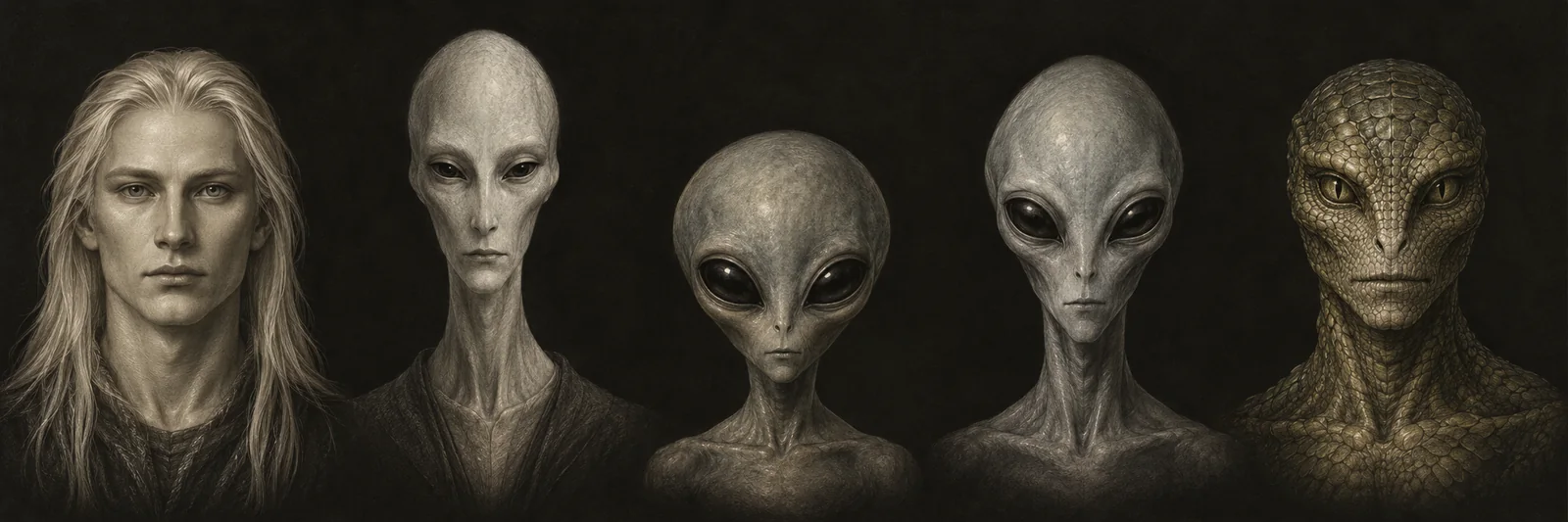
This entry documents a motif and its sources. It does not establish an alien species, home world, anatomy or capability.
What are Nordic aliens, and where does the name come from?
Nordic aliens are humanlike figures in encounter literature, often portrayed with fair hair. The name describes an appearance in a story. It is not a scientifically recognized species and does not establish a home world or a real visitor.
This guide uses George Adamski’s dated account as one traceable source for the modern humanlike visitor motif. It does not claim that Adamski coined the word Nordic or that his narrative was the first such story anywhere.
How did George Adamski’s account shape the motif?
Adamski said he met a humanlike visitor from Venus in the California desert on November 20, 1952. That is a firsthand claim in the sense that Adamski presented himself as the witness. It is not an independently established event.
Desmond Leslie and Adamski published Flying Saucers Have Landed in 1953. The Smithsonian Libraries catalog confirms the book, authors and date. It documents publication of the account, not a visitor from Venus.
The Smithsonian National Air and Space Museum places friendly humanlike contactee stories within the culture of the 1950s. That historical pattern helps explain how the motif circulated. It does not turn repeated descriptions into corroboration.
Are Nordics, Pleiadians and Tall Whites the same?
This guide keeps the labels separate. Nordic is used here for a reported humanlike appearance. Pleiadian would add a claimed place of origin. Tall Whites is reserved here for Charles Hall’s much later published Nevada narrative.
These are editorial definitions, not a scientific taxonomy. The useful method is to identify the source for each account, when it appeared and what evidence accompanies it. The Tall Whites guide examines Hall’s account separately.
What is documented, and what remains unproven?
The 1953 book is documented. Adamski’s public role in the contactee movement is documented. The Center for UFO Studies records both his influence and longstanding criticism of his claims.
The cited records do not independently verify that the alleged visitor existed, came from Venus or belonged to any extraterrestrial population. An archive about a claim is evidence that the claim entered the record. It is not evidence that the extraordinary event occurred.
How should a Nordic alien account be checked?
Start with the earliest source that can be dated. Separate what the named witness said from what later authors added. Check whether alleged photographs, samples or recordings have documented provenance and can be examined independently.
Resemblance alone is weak evidence. Two stories can describe similar figures because of shared culture, later influence or coincidence. A reliable extraordinary claim needs more than a familiar portrait.
Questions about Nordic alien names and evidence
Are Nordic aliens a scientifically recognized species?
No. Nordic alien is a descriptive label in encounter literature. The reviewed sources do not establish a biological species, a home world or a verified extraterrestrial visitor.
Are Nordic aliens and Pleiadians the same?
This guide does not treat them as interchangeable. Nordic is used here for a reported humanlike appearance. Pleiadian would add a claimed place of origin. Neither term is a scientific classification.
Did George Adamski call the visitor a Nordic alien?
This guide does not attribute the term Nordic to Adamski. It uses Nordic as an editorial category for the humanlike visitor account presented by the George Adamski Foundation.
What evidence would verify a Nordic alien account?
Verification would require records with documented provenance, independent corroboration and physical or sensor evidence that qualified investigators could examine. Similar descriptions in repeated stories do not meet that standard.
Nordics are a recurring figure in UFO encounter literature: visitors who resemble humans, usually described with fair hair and a striking or idealized appearance. The label tells readers how a figure is portrayed in a story. It does not establish a species or a place of origin.
A named account
A useful starting point is George Adamski's account of a meeting in the California desert on 20 November 1952. His foundation reproduces passages from Flying Saucers Have Landed in which he describes a youthful, human-looking visitor and a warning about the radiation associated with atomic weapons. Those passages are evidence for the content of Adamski's account. The foundation advocates his claims, so its presentation should not be mistaken for independent verification.
How an image travels
This is also why a gallery of alleged beings needs more than a portrait. A description can circulate through books, lectures, illustrations, and later encounter reports. Similar imagery may reflect a shared experience, cultural influence, or a mixture of influences; resemblance alone does not decide between them. The historical question is how the account developed and who reported what. The scientific question requires evidence that can be examined independently.
Our Nordics entry therefore follows the stories back to named claimants and dated publications. It keeps the familiar name while resisting the temptation to turn a collection of descriptions into a fixed biological classification. For this guide, Nordics remains a descriptive editorial label. It is not automatically interchangeable with Pleiadians or Tall Whites, which this guide treats as separate account categories.
George Adamski: a 1952 claim published in 1953
A traceable precursor to this humanlike visitor motif is George Adamski’s account of an alleged encounter on November 20, 1952. Desmond Leslie and Adamski published Flying Saucers Have Landed in 1953. The encounter date is a claim within that account; the book’s publication is a separate documentary fact.
Adamski described a humanlike visitor whom he associated with Venus. This entry uses Nordics as a later descriptive category. It does not claim that Adamski coined that label or that his account was the first humanlike visitor story anywhere.
The George Adamski Foundation presents and promotes his account. It is a source for what he claimed, not independent confirmation. We link to the Foundation and do not copy its photographs or illustrations.
Dated sources for this entry
- George Adamski Foundation: the claimed November 20, 1952 landing
- Smithsonian Libraries: Flying Saucers Have Landed, 1953 catalog record
- Smithsonian National Air and Space Museum: history of contactee accounts
- Center for UFO Studies: contactee history and criticism
| Claimed | What the cited record shows |
|---|---|
| Adamski met a humanlike visitor from Venus in 1952. | His published narrative and the Foundation’s presentation document the claim. They do not independently verify the visitor’s identity, origin or the encounter. |
| Humanlike appearance identifies a distinct extraterrestrial population. | The motif recurs in contactee literature. A recurring description is not evidence of a biological population. |
Compare with case records
These files offer separate evidence trails to compare. Their inclusion does not mean that witnesses in those cases reported this figure or that the cases establish an alien identity.
Follow the sources
- George Adamski Foundation: The Landing Reproduces the claimant’s 1952 encounter account; advocacy source
- Smithsonian Libraries: Flying Saucers Have Landed Catalog record for the 1953 book by Desmond Leslie and George Adamski
- Smithsonian National Air and Space Museum: The Study of Flying Saucer Sightings Historical context for friendly humanlike contactee accounts in the 1950s
- Center for UFO Studies: Contactees Historical summary of contactee claims, influence and criticism; not encounter verification
- NASA UAP frequently asked questions Official scientific evidence context; checked October 12, 2026
Each source note identifies the context and evidence it supports. Linked material establishes only the claims described in its source note. Official attribution and publication do not eliminate uncertainty. Read our editorial standard.
This is original research and analysis assisted by AI and compiled from the linked sources. It has not received independent expert review. We distinguish source findings from our interpretation and record substantive corrections. Corrections policy