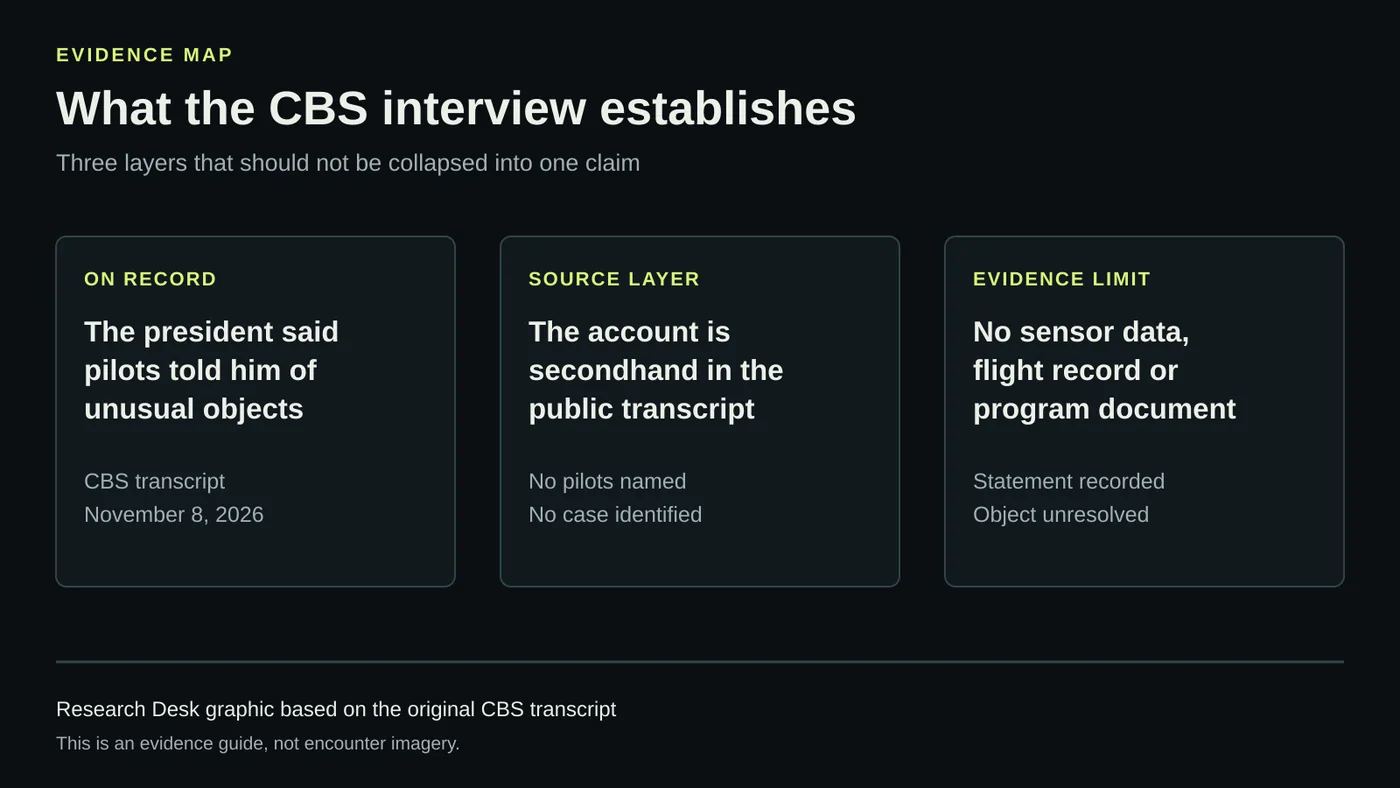
The CBS transcript establishes what the president said. It does not identify the pilots, connect the account to a documented case or supply evidence of a hidden program.
President Donald Trump told CBS that Air Force pilots had described unusual objects to him, but he did not identify a case or provide supporting records. When asked about allegations of a secret UAP program, he said he had seen no evidence of one and had not heard that such a program existed.
The comments appear in the full 60 Minutes transcript published on November 8. CBS says the interview was recorded at the White House on the preceding Friday. The CBS transcript is the original record reviewed here.
What did Trump say about the pilots?
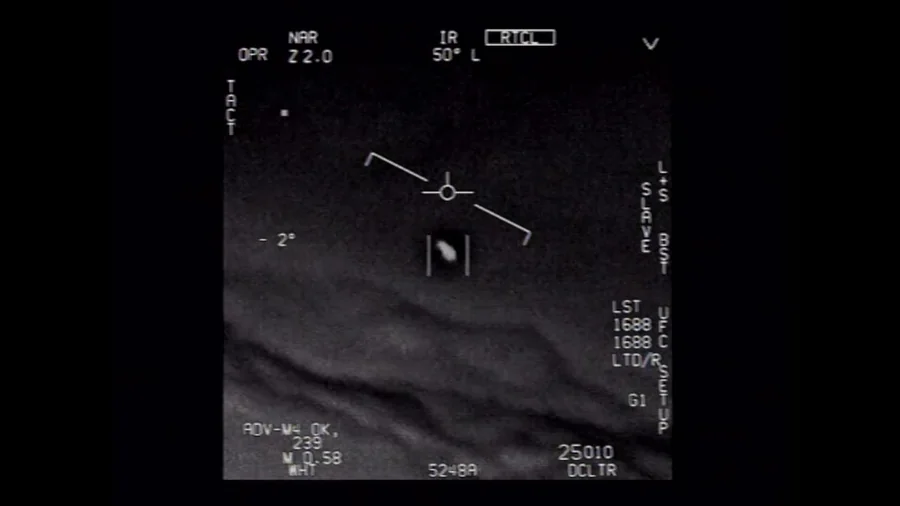
Trump said he met Air Force pilots in the Oval Office during his first term and part of his second term. He described them as credible professionals and said they had told him unusual things. His one concrete example was an account of a round object passing an F 22 at an estimated three times its speed.
This is a secondhand account. Trump did not say that he observed the object, reviewed sensor data or saw an incident report. The transcript does not name the pilots, identify a date or location, explain how speed was measured or connect the description to a released government file. Those missing details prevent comparison with radar, flight logs, weather, training activity or other evidence.
What did he say about a secret program?
CBS correspondent Ross Douthat asked whether Trump had seen evidence supporting claims that a secret program exists beyond presidential knowledge. Trump answered no and said he had not heard of such a program. He added that he would ask about it after the interview.
That answer establishes the president’s stated knowledge at the time of the interview. It does not prove that no undisclosed activity exists, and it does not corroborate whistleblower allegations. The public record would change only if an identifiable office, document, budget record, witness with direct access or other inspectable evidence emerged. Our David Grusch profile separates firsthand roles from later allegations relayed by sources.
How should the statement be weighed?
A senior official repeating a pilot account is newsworthy because it places the statement on the public record. Credibility and evidence remain separate questions. A pilot may accurately report an observation while the object’s identity, distance and speed remain uncertain. A president may accurately repeat what a pilot said without independently verifying the underlying event.
AARO’s FY2025 report says unresolved cases often lack the data needed for attribution and reports no verified evidence of extraterrestrial beings, activity or technology. NASA likewise says the available peer reviewed literature contains no conclusive evidence of extraterrestrial origin for UAP. Those positions do not identify the object in Trump’s story because no identifiable case was supplied.
Readers can compare the new statement with our CBS UAP evidence review, the government records guide and the PURSUE release tracker.
Review scope: the original CBS transcript and program page, AARO’s FY2025 report and NASA’s UAP evidence guidance. No named pilot, incident file, sensor record or follow up from the White House was available in the reviewed sources.
Follow the sources
- CBS News and 60 Minutes: Donald Trump post midterm interview transcript Published November 8, 2026 at 7:00 p.m. Eastern. Original transcript and embedded program page reviewed November 9, 2026.
- AARO FY2025 annual report (PDF) Official report; publication index lists July 20, 2026
- NASA UAP frequently asked questions Official scientific evidence context; checked October 12, 2026
Each source note identifies the context and evidence it supports. Linked material establishes only the claims described in its source note. Official attribution and publication do not eliminate uncertainty. Read our editorial standard.
This is original, AI-assisted research and analysis compiled from the linked sources. It has not received independent expert review. We distinguish source findings from our interpretation and record substantive corrections. Corrections policy