MMX is a planned investigation of the Martian moons and their material. No returned sample or detection of life is established by these mission announcements.
Japan’s Martian Moons eXploration mission offers a concrete way to investigate an old question: where did Mars’s two moons come from? Rather than relying only on their appearance from afar, MMX aims to bring material from Phobos into laboratories on Earth.
In an October 15 article, NASA outlined its instruments, sampling contribution and support for the JAXA-led mission. That is a prelaunch account. The launch date was announced by JAXA on August 20; neither announcement establishes a completed flight or a scientific discovery.
When is MMX scheduled to launch?
JAXA’s schedule sets H3 flight 10 for October 20, 2026 at 04:41:03 Japan Standard Time from Tanegashima Space Center. That corresponds to October 19 at 12:41 p.m. Pacific and 3:41 p.m. Eastern, rounded to the minute. The mission homepage still identifies it as scheduled as of October 16. Launch plans can change.
Two origin hypotheses, one physical test
JAXA’s mission overview describes competing explanations: Phobos and Deimos could be captured asteroids, or bodies assembled from debris after a large impact on Mars. MMX would combine close observations with analysis of at least ten grams of Phobos material returned to Earth.
The practical distinction is between a surface that resembles a class of objects and material whose composition and history can be examined directly. A successful return would provide a different kind of evidence, while the interpretation would still depend on what the samples actually contain.
Why this matters to the search for life
JAXA’s science description also proposes looking for material thrown off Mars by impacts and deposited on Phobos. Such grains might preserve clues to past water, organic chemistry and potentially biosignatures. This is a reason to investigate the samples, not evidence that those clues have already been found.
Our reading of these objectives separates three questions: where a grain originated, what environment it records, and whether any feature requires a biological explanation. An answer about ancient habitability does not automatically answer the last question. The K2-18 b evidence guide explores that distinction in a different setting, using atmospheric observations.
What has to happen before a laboratory result?
ESA’s October 13 preview describes a sequence of Mars arrival in August 2027, close study of Phobos, deployment of the Idefix rover, and later sampling by the main spacecraft. The return target is 2031. Each remains a planned milestone.
NASA’s MEGANE instrument is intended to measure elemental composition using gamma rays and neutrons. Its P-Sampler would use nitrogen bursts to gather surface material, complementing JAXA’s coring sampler. NASA also plans communications and navigation support through the Deep Space Network and curation of about 15% of the returned material.
For readers following the mission, launch confirmation, successful sampling, capsule recovery and published sample analyses will be separate evidence checkpoints. A dramatic launch image cannot stand in for the later laboratory work.
Sources and review limits
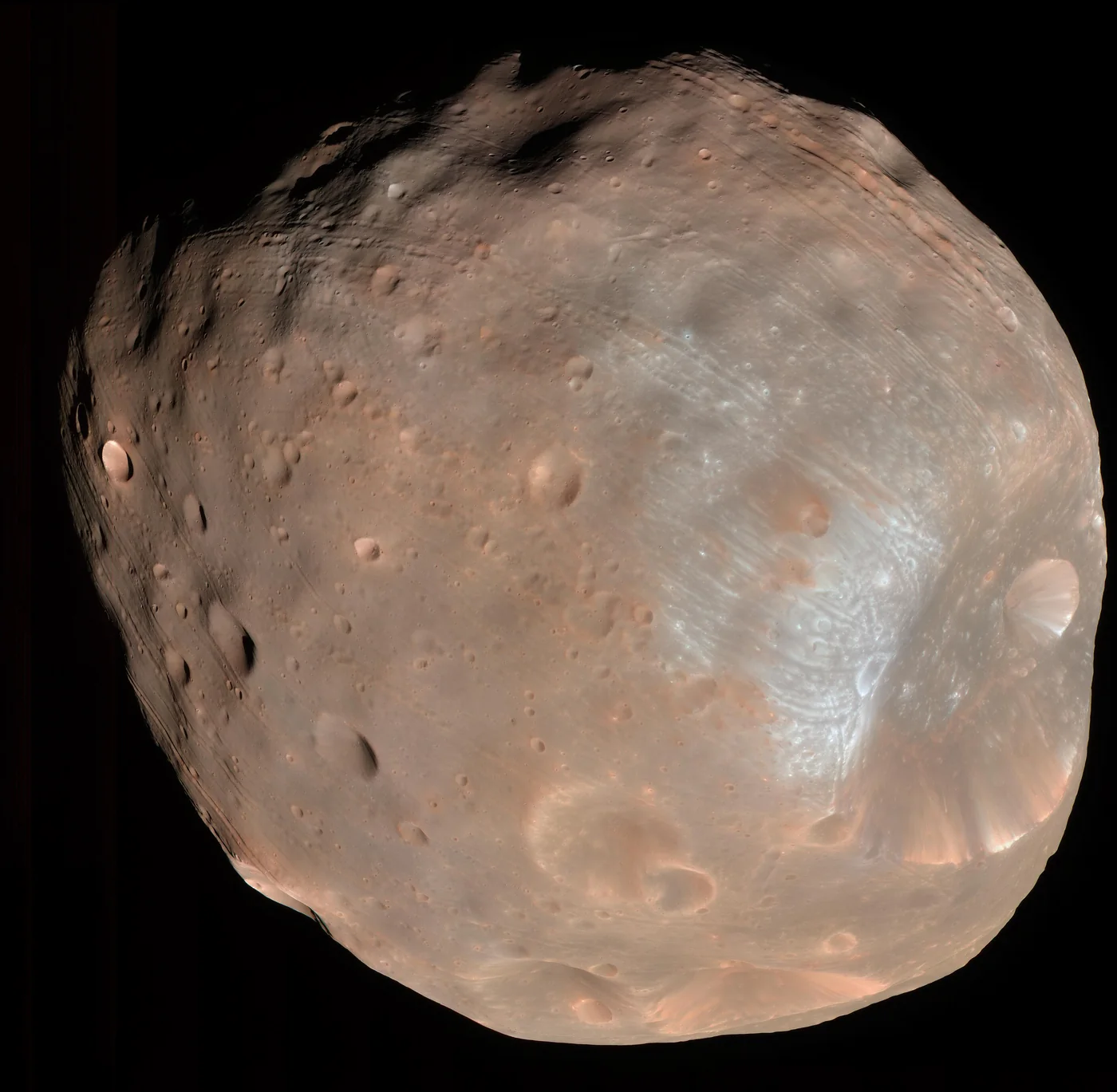
We reviewed the original JAXA, NASA and ESA written material linked here. This preview does not report spoken claims from NASA’s briefing, whose recording we have not reviewed. Detailed landing schedules remain plans; this article gives the broad sequence rather than assigning a fixed sampling date. The photograph above predates MMX by eighteen years.
Follow the sources
- JAXA: H3 F10 / MMX launch schedule August 20, 2026 announcement; scheduled launch October 20 at 04:41:03 JST. Target, not completed launch.
- JAXA: current MMX mission status Checked October 16, 2026; homepage still labels the October 20 launch scheduled.
- JAXA: MMX mission overview and sequence Original mission overview reviewed October 16, 2026; proposed observations, sampling and return.
- JAXA: MMX science objectives Original science overview reviewed October 16, 2026; origin hypotheses and possible Martian material. These are research objectives.
- NASA: contributions to the Martian moons mission Patricia Talbert; article dated October 15, 2026, page updated October 16. Written release reviewed; briefing recording not reviewed.
- ESA: Mars moon lander launch preview October 13, 2026; mission sequence, rover and sample-return plans.
Each source note identifies the context and evidence it supports. Linked material establishes only the claims described in its source note. Official attribution and publication do not eliminate uncertainty. Read our editorial standard.
This is original, AI-assisted research and analysis compiled from the linked sources. It has not received independent expert review. We distinguish source findings from our interpretation and record substantive corrections. Corrections policy